
What this guide covers
- What school readiness really means in the South African context - beyond "can write their name"
- Why the one-off readiness test arrives too late and tells the receiving teacher too little
- The NCF and the six ELDAs - the developmental journey from birth through to Grade R
- The six readiness domains - what to look for, in plain classroom language
- Red flags - what to flag early, and what is simply normal uneven development
- Writing a handover the Grade 1 teacher will actually use - with before-and-after examples
- How EarlyTrack handles it - the developmental journey gathered automatically, ending in a School Readiness Report
What "school readiness" really means in South Africa
Ask ten people what makes a child ready for Grade 1 and most will say "they can write their name" or "they know their letters". Those are the easiest things to see, which is exactly why they mislead. School readiness is far broader, and the South African research is clear about it.
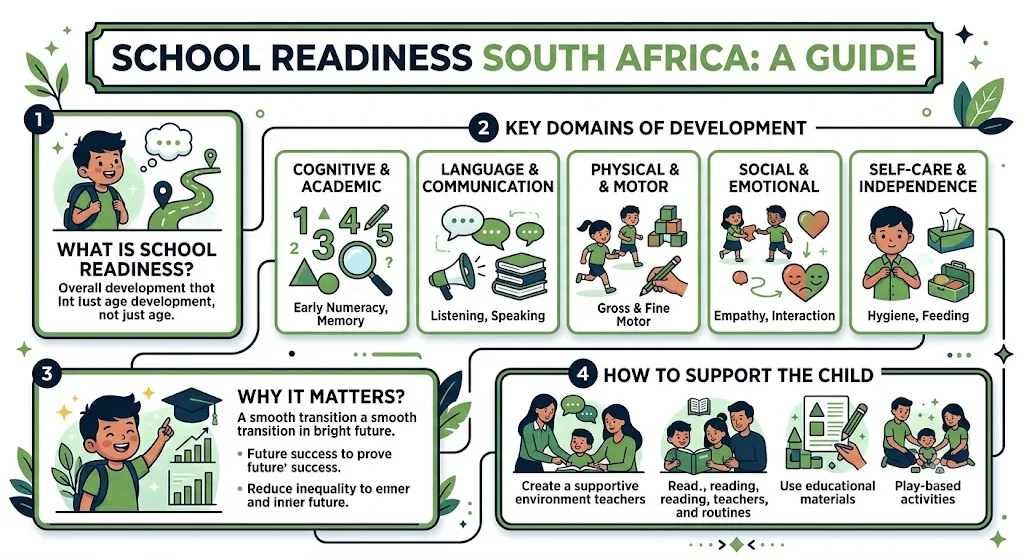
Readiness is a child's developmental preparedness across several areas at once: the body, the mind, language, getting along with others, managing feelings, and managing themselves. The Western Cape Education Department puts emotional readiness first in its own guidance for parents - a child must be able to manage their emotions, be reasonably independent, and cope with being separated from a caregiver. The pencil grip comes later.
This matters because a child can look ready and not be, or look behind and simply need a little more time. A child who reads early but falls apart when a routine changes is not more ready than the quiet child who shares, waits, listens, and recovers from a disappointment. Readiness is the whole child.
In South Africa, Grade R has been part of the Foundation Phase since 1998, and CAPS sets out assessment standards a child is expected to reach by the end of the Grade R year. Readiness is the bridge to those standards - built long before Grade R begins.
Why the one-off readiness test misses the point
For decades, school readiness in South Africa has meant one thing in practice: a test, near the end of the preschool year, often administered by an educational psychologist. The Susan le Roux Group Test for School Readiness is the best known - it produces a single readiness figure, with a child scoring under roughly 63% flagged as "not yet school ready". Others combine the cognitive Group Test for Five-and-six-year-olds with the Bender Gestalt for visual-motor development, or the E3SR screening for emotional and social readiness.
These tests are well-built and useful when a decision is genuinely unclear. But as the only measure, the one-off test has three problems. It arrives too late to do much about what it finds. It captures a single morning - a nervous child on a strange day can score poorly. And it tells the receiving teacher a result without the story behind it.
Even the international software industry has started saying this out loud. One of the largest preschool platforms now argues in its own writing that readiness systems built on age-based "a child should be doing X by age Y" checklists create anxiety for families and miss the reality that development is variable and non-linear. They are right. The alternative is not a better test. It is better tracking.
The developmental journey: the NCF and the six ELDAs
South Africa already has the framework for tracking readiness as a journey. For children from birth to four, the National Curriculum Framework (NCF) sets out how young children grow and learn. From Grade R, the CAPS curriculum takes over. Running through both are the six Early Learning and Development Areas - the ELDAs - which describe the dimensions of a child's development. They are the same six areas EarlyTrack uses throughout its ELDA assessment tools.
Physical health, gross and fine motor development, safety, and the self-care that underpins independence at school.
Confidence, relationships, managing emotions, and the sense of self that lets a child separate from home and join a group.
Listening, speaking, early literacy, and following instructions - in the child's home language and beyond.
Number sense, pattern, shape, and the early reasoning that becomes Grade R and Grade 1 maths.
Imagination, music, movement, and art - and the problem-solving and expression that come with them.
Curiosity about people, places, nature, and how things work - the foundation of later science and social study.
The point of the ELDAs is that they are not a Grade R checklist. They describe development from birth. A toddler builds well-being and communication years before anyone mentions Grade 1. If you observe and record against these areas as the child grows, readiness is not something you scramble to measure at the end - it is something you have been watching the whole time.
The four NCF phases of the journey
Development is continuous, but it helps to think in phases. The NCF sets out four broad phases for planning, linked to the NELDS age guidelines for babies, toddlers and young children. Readiness builds quietly through all of them - long before the Grade R year begins.
- 1BeginningBabies · 0 to 18 months
Trust, attachment, early communication, and gross motor foundations - sitting, crawling, walking.
- 2Moving onToddlers · 18 to 36 months
The language explosion, growing independence, first social play, and the beginnings of fine motor control.
- 3Advancing furtherYoung children · 3 to 4 years
Longer attention, richer language, sharing and turn-taking, emerging pencil control, and first pre-literacy and pre-maths.
- 4Towards Grade R4 to 5 years
The full readiness picture coming together: motor control, pre-academic skills, independence, and social-emotional maturity.
Seen this way, the final-year readiness question becomes a summary of years of observation, not a verdict delivered cold.
The six readiness domains
When you sit down to judge whether a child is ready for big school, these are the areas to weigh. None of them stands alone, and a child rarely sits at the same level across all six.
Runs, jumps, balances; holds a pencil and scissors with control; can manage buttons, a lunchbox, and the bathroom independently.
Recognises patterns, counts with meaning, knows some letters and sounds, completes a puzzle, and concentrates on a task to the end.
Speaks in full sentences, follows two- and three-step instructions, listens in a group, and can express a need or a feeling in words.
Shares, takes turns, plays with others, resolves small conflicts, and responds to an adult who is not a parent.
Separates from a caregiver, manages frustration, recovers from disappointment, and shows growing confidence in new situations.
Follows a routine, tidies up, attends to personal needs, and sustains attention without constant one-to-one support.
Red flags - what to flag, and what not to
The purpose of watching closely is not to label children. It is to catch the child who needs more support early enough that something can be done - a referral, a conversation with the family, a plan with the receiving school, or simply another year to grow.
A single weak observation is never a red flag. Children have bad mornings, off weeks, and uneven spurts. What matters is a consistent pattern across a term or more in one or more domains:
- Cannot hold a pencil or use scissors with any control by the final year.
- Speech that is hard to understand, or very limited language for their age.
- Cannot follow a simple two-step instruction after repeated practice.
- Cannot separate from a caregiver without prolonged distress, well into the year.
- Cannot regulate emotions enough to function in a group most days.
- Shows no interest in other children, or cannot share or take turns at all.
Flag these the way a professional does: specifically, kindly, and early. "Cannot concentrate" helps no one. "Sustains focused attention for about three to four minutes on a chosen task, then needs redirection - observed consistently across Term 2" gives the family and the next teacher something real to work with.
Writing a readiness handover the Grade 1 teacher will use
This is where most readiness reporting falls down. A score, a tick-box, or a single warm paragraph tells the receiving teacher almost nothing. A great handover is specific, balanced, and forward-looking. Here is the difference.
"Lerato is a lovely child and is ready for school. She gets on well with everyone."
"Lerato separates easily, plays cooperatively, and resolves small conflicts with words - a real strength. She follows two-step instructions reliably and counts to 20 with meaning. Fine motor control is still developing: her pencil grip is functional but tires quickly, so longer writing tasks will need short breaks at first. A confident, settled starter who will benefit from extra fine-motor practice early in Grade 1."
The second version takes a minute longer to write and saves the Grade 1 teacher a month of guessing. It names a strength, gives concrete evidence, flags one area to watch without alarm, and ends with a practical suggestion. That is what a developmental journey, handed over well, looks like.
School readiness in South Africa
The readiness gap in South Africa is real and it opens early - often before a child ever reaches Grade R. That is the argument for tracking readiness as a journey from the youngest ages, not testing for it at the end. The earlier a concern is seen, the more time everyone has to close the gap.
How EarlyTrack's Milestone Tracker handles this
This is exactly what we built the Milestone Tracker for. Instead of a frantic test in the final term, EarlyTrack follows each child's developmental journey along the NCF and the six ELDAs - built entirely from the observations teachers already capture week to week. Nothing extra to administer; the record assembles itself as you teach.
When a child reaches the Grade R transition, EarlyTrack produces a branded School Readiness Report - a complete developmental story across all the readiness domains, with observed evidence, strengths, areas still developing, and any concerns flagged in time for the receiving school to plan. The family sees their child's whole journey. The next teacher starts from knowledge. The child arrives as someone already known.
It is the difference between sending a child to big school with a half-page, and sending them with years of careful observation, gathered the whole way.
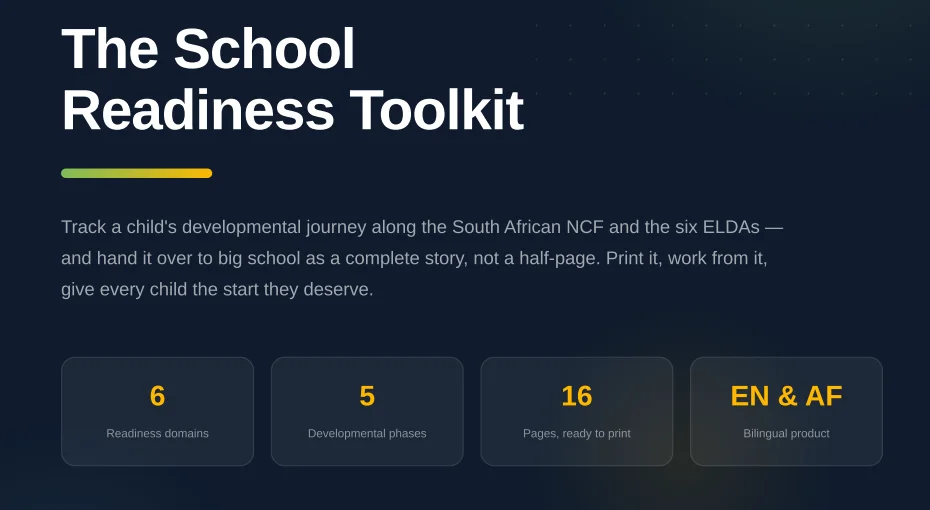
Everything in this guide in one printable PDF. All six readiness domains, phase-by-phase milestones, a weekly observation log, a four-term planner, a red-flag protocol, handover comment starters, and a ready-to-use School Readiness Report template. Pin it above your desk for the final year.
⬇ Download free PDFFrequently asked questions
What is school readiness in South Africa?
It is a child's developmental preparedness for formal schooling across physical, cognitive, language, social, emotional, and self-management areas. In South Africa it is shaped by the NCF for birth to four, the Grade R CAPS standards, and the six ELDAs. Readiness is a journey built over years, not a single test.
At what age should a child start Grade 1?
A child must turn six by 30 June of the year they start Grade 1. But age is only one factor - developmental readiness across the domains matters more than the calendar. An age-eligible child who is not developmentally ready may benefit from another year to grow.
How is school readiness assessed here?
Traditionally through a one-off psychometric test near the end of the preschool year. A stronger approach is continuous, observation-led tracking across the whole journey, aligned to the NCF and the six ELDAs, ending in a readiness report the Grade 1 teacher can actually use.
What should a school readiness report contain?
All the readiness domains - motor, cognitive and pre-academic, language, social, emotional, and self-management - with specific observed evidence rather than scores alone, clear strengths, areas still developing, and any concerns flagged early enough for the receiving school to plan support.
What are the warning signs a child is not ready?
A consistent pattern across a term or more in one or more domains - not a single weak observation. Examples: no pencil control by the final year, very limited language, cannot follow a two-step instruction after practice, cannot separate from a caregiver, or cannot regulate emotions in a group most days.
Does EarlyTrack produce a school readiness report?
Yes. The Milestone Tracker follows each child's journey along the NCF and the six ELDAs, built from observations teachers already capture, and produces a branded School Readiness Report at the Grade R transition - for the family and the receiving school.
Give every child a developmental journey worth handing over.
EarlyTrack's Milestone Tracker follows each child along the NCF and the six ELDAs, and produces a branded School Readiness Report at Grade R transition - built from the observations you already capture. Try it free for 14 days.
Start Free 14-Day Trial