
What is ELDA and where does it come from?
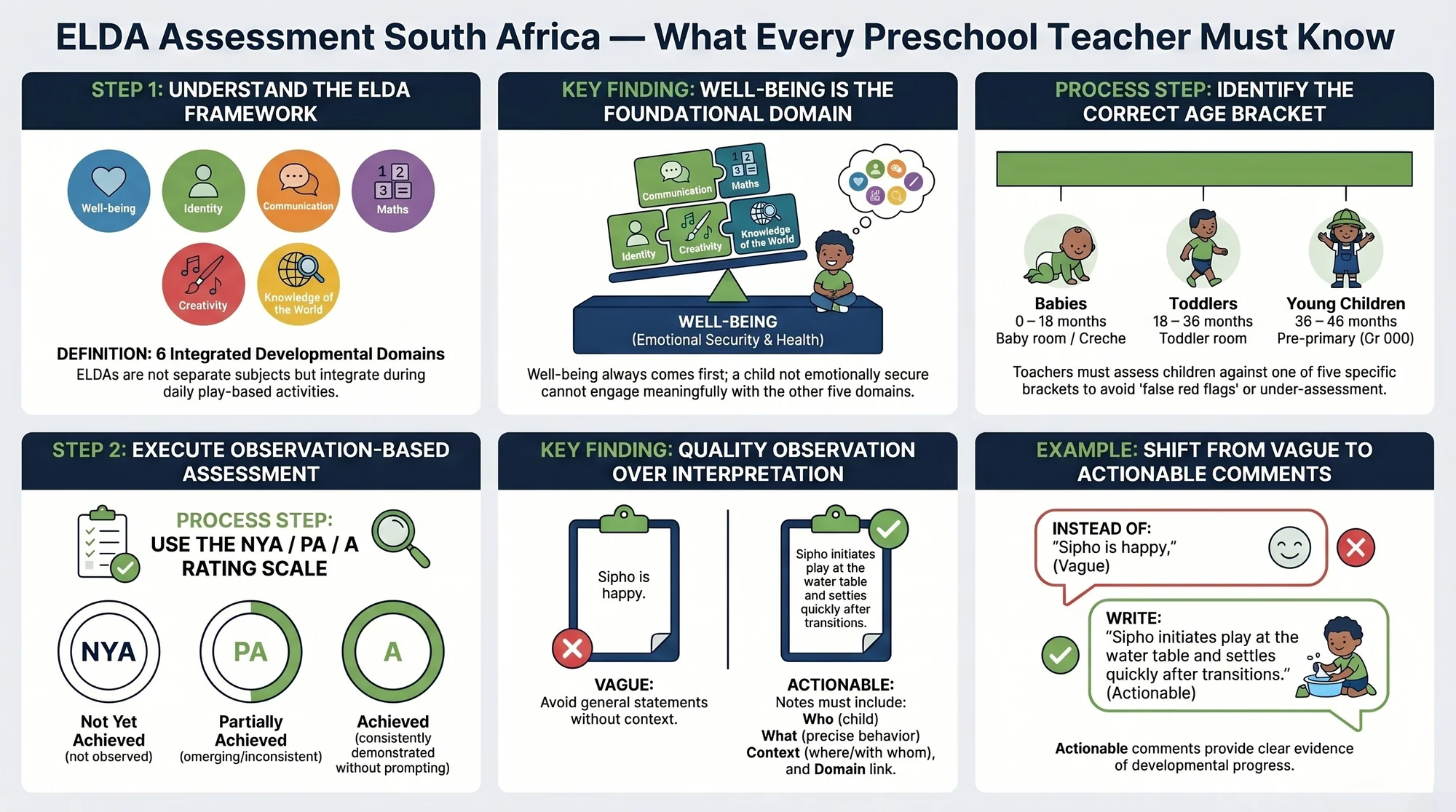
ELDA stands for Early Learning and Development Area. The six ELDAs are the developmental domains defined in South Africa's National Curriculum Framework (NCF) for children from birth to four years, published by the Department of Basic Education in 2015. They are the framework South African ECD centres are expected to follow for all children in registered programmes before they reach Grade R.
If your school is a registered ECD centre or a preschool serving children below school-going age, ELDA is your curriculum framework - the way CAPS is the framework for Grade R. Most private preschool teachers in South Africa know that ELDA exists, but many have never had it explained clearly in teacher language. The DBE framework document is 80 pages of policy text. This guide is the practical version.
The NCF replaces an earlier set of National Early Learning Development Standards (NELDS), which were widely used but later identified as insufficiently aligned with social transformation and quality goals. The ELDAs reflect a more holistic, child-centred approach - prioritising observation, play-based learning, and integration of developmental domains rather than subject-based instruction.
According to the Department of Basic Education, there are approximately 42,420 early learning programmes in South Africa serving around 1.6 million children under five. The 2024 Thrive by Five Index - South Africa's largest national survey of preschool outcomes - found that only 42% of children enrolled in early learning programmes are developmentally on track. For children not enrolled in any programme, only 18% are on track. The quality of assessment and responsive teaching in ECD centres matters more than most people realise.
The six ELDA domains explained for teachers
Each of the six ELDAs describes a broad area of children's development and learning. They are not separate subjects - they integrate with each other continuously. A child building a block tower is demonstrating Exploring Mathematics (shape, space, balance), Creativity (design and expression), Well-being (physical coordination), and Communication (if they describe what they are building). ELDA teaching and assessment happen during ordinary daily activities, not in separate lesson slots.
Well-being always comes first in ELDA assessment. A child who is unwell, insecure, or emotionally dysregulated cannot engage meaningfully with any of the other five domains. When you notice a pattern of NYA ratings across multiple domains for one child, check the Well-being domain first - it is usually the root cause.
The five ELDA age brackets
ELDA assessment is not one-size-fits-all. The developmental expectations within each domain change significantly across the five age brackets. A skill that is age-appropriate for a three-year-old looks completely different at eighteen months. EarlyTrack organises all 964 ELDA skills across these five brackets so teachers are always assessing children against the right developmental expectations for their age.
| Age Bracket | Age Range | Typical Setting | Key Focus Areas |
|---|---|---|---|
| Babies | 0 to 18 months | Baby room, creche | Attachment, sensory exploration, early movement, pre-language sounds, feeding, sleep |
| Toddlers | 18 to 36 months | Toddler room | Walking, running, early speech, parallel play, independence in self-care, first friendships |
| Young Children | 36 to 48 months | Pre-primary, Gr 000 | Complex play, growing vocabulary, early literacy and number exposure, creative expression |
| Older Children | 48 to 60 months | Pre-primary, Gr 00 | Extended storytelling, counting with understanding, group problem-solving, emotional regulation |
| Towards Grade R | 60 to 72 months | Pre-Grade R, Gr 0 | School readiness, phonological awareness, numeracy consolidation, social competence, transition preparation |
For mixed-age ECD centres - which describe most registered preschools in South Africa - this means your assessment system needs to handle multiple brackets running simultaneously in one class. A teacher with children aged three to five in the same room is assessing children at three different brackets. EarlyTrack links each child to their correct bracket automatically when you enter their date of birth.
A common mistake in ELDA assessment is applying the same skill list to every child in a class regardless of age. A child who is NYA on a skill that is appropriate for an older age bracket is not behind - they are simply not in that bracket yet. Accurate bracket assignment prevents both under-assessment and false red flags.
The NYA / PA / A rating scale
ELDA uses a three-level rating scale. This is different from the Grade R CAPS four-point numeric scale (1 to 4). Many teachers who transfer from Grade R to a younger class initially try to apply the 1 to 4 scale to ELDA children - it does not map cleanly and creates confusion in report writing.
A rating of NYA is not a failure and should not read like one in your report comments. It means "we have not yet observed this skill emerging in a consistent way." The comment that accompanies the rating carries the real information - what you have observed, what the child is doing instead, and what the next step looks like.
One practical rule that experienced ELDA teachers follow: do not rate a skill NYA without first asking whether you have created the conditions for it to emerge. If a child is NYA in the Creativity domain, the question is whether they have had regular, unhurried access to art, music, and dramatic play - not whether they have a creativity deficit.
Writing ELDA observation notes that mean something
ELDA assessment is entirely observation-based. No formal tests, no worksheets, no sit-down assessments. You watch what children do naturally during play, routines, and activities, and you record what you see. The quality of your observation notes determines the quality of your reports.
A useful ELDA observation note has four components:
- Who: The child's name and age bracket
- What: A precise description of what the child did - the actual behaviour, not an interpretation of it
- Context: Where, when, and with whom - this matters because skills often only emerge in specific contexts
- Domain link: Which ELDA domain and skill this observation relates to
"Thabo (48 months, Older Children bracket) - during outdoor play this morning, counted the stones he was collecting into a bucket, pointing to each one and saying the number aloud up to nine before losing count. He repeated this three times with different collections of objects. Exploring Mathematics - counting with one-to-one correspondence."
This is a useful observation. It tells you exactly what the child did, in what context, and how many times - which tells you whether it was a one-off or an emerging consistent behaviour. It is also ready to translate directly into a report comment.
What does not work is the kind of observation note that says: "Thabo is good at maths." This tells a parent nothing useful, tells a principal nothing assessable, and tells an inspector nothing compliant. Every ELDA observation note should describe behaviour, not character.
Before-and-after comment examples for all six domains
The before-and-after examples below show the difference between a comment that is technically compliant and one that is genuinely informative to parents and legally defensible during a DSD or Bana Pele inspection. The "after" versions can be adapted using EarlyTrack's AI comment generator, which produces English and Afrikaans versions per child per domain.
🏠 Domain 2 - Identity and Belonging
"Amahle is a friendly child who knows the class rules."
"Amahle consistently greets peers and teachers by name and shows awareness of classroom routines without reminders. She speaks confidently about her family and home community during group discussions and is beginning to show interest in the cultural practices of other children in the class. Next step: provide opportunities for Amahle to take on a leadership role in small group activities."
💬 Domain 3 - Communication
"Lethabo likes books and talks a lot."
"Lethabo chooses picture books independently during free play and retells familiar stories using four or five key events in sequence. She is experimenting with rhyme in her speech and shows early awareness of print direction - pointing to where reading begins on a page. Next step: offer opportunities for Lethabo to dictate her own stories for a teacher to write down, reinforcing the connection between spoken and written language."
🧮 Domain 4 - Exploring Mathematics
"Ruan can count and knows his shapes."
"Ruan counts objects to 12 with reliable one-to-one correspondence and identifies the numerals 1 to 8 in the classroom environment. He sorts objects by two attributes simultaneously (colour and size) during play. Next step: introduce activities that invite Ruan to predict quantities before counting - estimating how many blocks are in a container - to strengthen early number sense beyond rote counting."
🎨 Domain 5 - Creativity
"Zanele enjoys art and music activities."
"Zanele uses the art area purposefully, choosing specific colours and materials to represent things from her experience - she recently created a detailed painting she described as 'the market near my grandmother's house.' In music sessions she moves rhythmically in response to tempo changes and has begun creating her own movement sequences. Next step: provide clay work to extend Zanele's three-dimensional expression."
🌎 Domain 6 - Knowledge and Understanding of the World
"Jayden is curious and likes nature."
"Jayden independently investigates objects in the outdoor environment, currently focused on insects. He uses comparative language (bigger, faster, the same as) when describing his observations and has begun representing his findings through drawing. He shows understanding of cause and effect - predicting what will happen when he pours water over different surfaces. Next step: introduce a simple plant-growing project to extend Jayden's investigation into living systems over time."
Everything in this guide in one printable PDF. All six ELDA domains, all five age brackets, comment starters per rating, observation log template, and an inspection-readiness checklist. Pin it above your desk at report time.
Red flags - when a child is consistently NYA
A single NYA rating in one domain in one term is not a red flag - it is a normal part of a child's uneven developmental progress. A red flag is a pattern: a child who is NYA across three or more skills in the same domain for two or more consecutive terms, particularly in Well-being or Communication.
When you identify this pattern, the appropriate steps are:
- Document the pattern clearly in the assessment records - dates, specific skills, contexts in which you have tried to observe the skill
- Discuss with the principal before raising it with the parent - the principal should see the evidence first
- The parent conversation should open with what the child is doing well, then describe the pattern without clinical language, then agree on a specific next step
- If the concern persists after one more term of targeted support, recommend an assessment by a speech therapist, occupational therapist, or educational psychologist as appropriate
- Record all conversations and decisions - dates, who was present, what was agreed
EarlyTrack flags children who are consistently NYA across multiple skills in the same domain with a red flag indicator on the principal's dashboard. This does not replace teacher judgement - it ensures nothing is missed in a class of 25 children across six domains.
ELDA vs Grade R CAPS - what changes at transition
South African private preschools often serve both ELDA-age children (birth to four) and Grade R children (five to six) in the same building, sometimes in adjacent classrooms. The frameworks are related - the NCF explicitly links to CAPS as the next step - but they are different in important ways.
| Feature | ELDA (NCF) | Grade R (CAPS) |
|---|---|---|
| Age range | Birth - 72 months | 60 to 72 months (school year) |
| Framework document | National Curriculum Framework (NCF) | Curriculum and Assessment Policy Statement (CAPS) |
| Structure | 6 developmental domains (ELDAs) | 3 subjects (HL, Maths, Life Skills) |
| Rating scale | NYA / PA / A (3 levels) | 1 / 2 / 3 / 4 numeric (4 levels) |
| Assessment approach | Observation-based, play-integrated | Observation-based, some structured activities |
| Formal tests | None | None (continuous assessment only) |
| Number of skills (EarlyTrack) | 964 across 5 age brackets | 98 across 3 subjects |
| AI comments (EarlyTrack) | ✓ EN and AF | ✓ EN and AF |
The transition from ELDA to Grade R is not a cliff - the Towards Grade R bracket (60 to 72 months) is specifically designed to prepare children for what CAPS requires. A child who has been well-assessed in the Towards Grade R ELDA bracket will enter Grade R with a profile that maps clearly onto the three CAPS subjects. See our companion guide on Grade R Assessment in South Africa for the CAPS side of the transition.
How EarlyTrack handles ELDA
EarlyTrack's ELDA assessment module was built specifically for South African preschools. The ELDA framework - all 964 skills across six domains and five age brackets - is loaded from day one. Teachers do not build spreadsheets, import CSV files, or reconstruct the framework at the start of every term.
When a new child is registered, their date of birth determines their age bracket automatically. The teacher opens the assessment for that child and sees only the skills relevant to their bracket and domain - not a list of 964 items to scroll through.
Observations are captured during the week using voice-to-text (Afrikaans and English speech models) or typed notes. By the end of term, most of the evidence is already there. The AI drafts observation comments in English or Afrikaans per child per domain - drawing on the specific observations captured during the term. The principal reviews and approves each comment before the report goes out. Nothing reaches a parent without the principal's sign-off.
For a broader view of how ELDA fits into the full range of management systems a South African preschool needs to run, the preschool management guide for South Africa covers all six systems in one place.
Frequently asked questions
What does ELDA stand for in South Africa?
What are the six ELDA domains?
What are the five ELDA age brackets?
What rating scale is used for ELDA assessments?
How is ELDA different from Grade R CAPS assessment?
How many ELDA skills does EarlyTrack include?
Stop rebuilding the ELDA framework every term.
EarlyTrack loads all 964 ELDA skills from day one - across six domains, five age brackets, in English and Afrikaans. Try it free for 14 days.
Start Free 14-Day Trial
🌿 Domain 1 - Well-being
"Sipho is doing well and seems happy at school."
"Sipho initiates play with peers at the water table without adult prompting and settles quickly after transitions between activities. He is beginning to manage brief separations from his caregiver with reassurance from a trusted teacher. Next step: encourage Sipho to use words to communicate his needs when he is upset rather than withdrawing."