
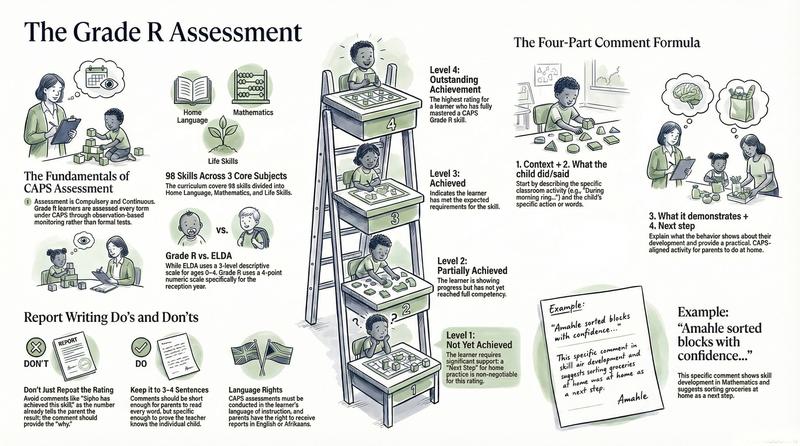
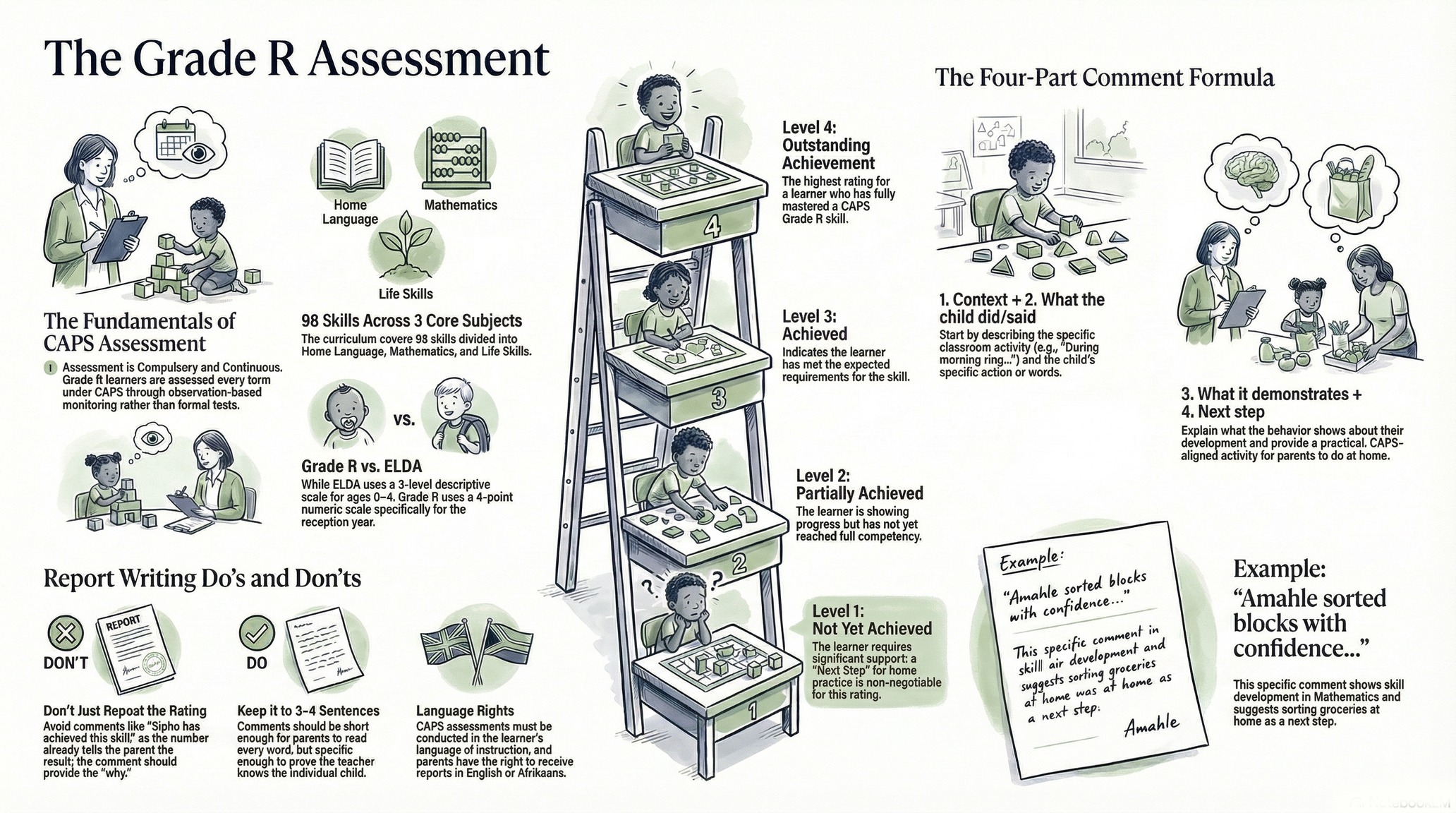
Grade R assessment in South Africa is governed by CAPS and covers 98 skills across three subjects - Home Language, Mathematics, and Life Skills. This guide explains what the framework requires, how the four-point numeric rating scale works, and how to write report comments that mean something to parents. It includes before-and-after comment examples for every subject, a practical workflow for managing the full CAPS Grade R assessment cycle, and a direct look at how EarlyTrack's Grade R assessment module handles the whole process without teachers rebuilding anything from scratch each term.
Key points
- CAPS Grade R assessment is observation-based - no formal tests. Continuous throughout the term, recorded using checklists, work samples, and observation notes.
- Four-point numeric rating scale (1 to 4) - Not yet achieved, Partially achieved, Achieved, Outstanding. Different from ELDA's three-level NS/D/A scale.
- 98 Grade R skills across three CAPS subjects - most teachers rebuild this grid from scratch each term. EarlyTrack loads it on day one, with correct term subsections.
- Report comments must add what the number cannot - observable evidence, context, and a next step. A rating of 1 or 2 without a comment is a compliance risk during DBE inspection.
- EarlyTrack's Grade R module - correct 1 to 4 scale, term-aware subsections, AI comments in English and Afrikaans, principal approval workflow, automated branded PDF reports.
It is the second-to-last week of term. The Grade R skill ratings are done. You have worked through Home Language, Mathematics, and Life Skills - all 98 boxes ticked. Now the comment fields are staring at you. Blank. Every single one.
It is 9pm. You have 26 learners. Tomorrow is the last teaching day before reports go home.
Nobody tells you this is the hardest part of Grade R assessment in South Africa. Your training covered child development, lesson planning, and the curriculum. But writing a report comment that actually means something to a parent - that was left to you to figure out alone.
Every Grade R teacher in South Africa knows this moment. According to the Department of Basic Education, 78% of South Africa's 21,207 Grade R teachers were not qualified to teach Grade R when last formally measured. Most are learning as they go - often without a single clear resource on how CAPS Grade R assessment works in practice. This guide is that resource.
What Is Grade R Assessment Under CAPS?
Grade R assessment is not a test. CAPS is explicit about this. Learners in Grade R are not sat down with pencils and question papers. CAPS Grade R assessment happens through watching, listening, and structured play. It is continuous - woven into every school day, every week, every term.
This matters because many Grade R teachers default to what they know from higher grades: formal tasks, written work, marked papers. CAPS states clearly that Grade R must not be a "watered-down Grade 1." The CAPS Grade R framework has its own logic, its own pace, and its own assessment requirements.
Grade R is the reception year - the bridge between early childhood development and formal schooling. The curriculum is structured, reporting expectations are defined, and the Grade R skills framework is specific to the South African CAPS context. It is not an ECD assessment tool adapted to fit. It is its own system with its own rules.
What Grade R teachers must keep throughout the term: dated work samples, observation notes, checklists, and photographs. These are the evidence behind every rating on the report card. Without evidence, the rating is a guess. During a DBE inspection, a classroom full of 3s with no records is exactly the kind of thing that gets flagged - and schools have been required to redo assessment processes under supervision because of it.
"The skill ratings were done on the last day from memory. There were no checklists, no observation notes, no work samples. The school had to redo the entire Grade R assessment cycle under DBE supervision. It is entirely avoidable with the right habits from Week 1." - Angelique, Co-Founder, EarlyTrack
The Three Grade R Subjects and What Gets Assessed
CAPS Grade R assessment covers three subjects. Each has specific Grade R skills, specific content areas, and specific things to observe during daily school activities. Knowing exactly what to look for in each subject is what separates confident Grade R teaching from end-of-term guesswork.
Home Language
Home Language covers listening and speaking, emergent reading, emergent writing, and phonics awareness. Grade R teachers observe whether a child can follow a two-step verbal instruction, retell a short story in sequence, or recognise the first sound in a familiar word. The CAPS Grade R Language skills are the foundations that formal reading instruction in Grade 1 will depend on.
Mathematics
Mathematics covers counting, number recognition, patterns, shapes, measurement, and early data handling. Grade R assessment in Mathematics is woven into daily routines - ring time, snack time, outdoor play, construction activities. You are observing whether a child can sort objects by one attribute, count a small set reliably, or identify a basic shape in a mixed group. Observation evidence for CAPS Grade R Mathematics skills is everywhere if you know what to document.
Life Skills
Life Skills is the broadest of the three Grade R subjects. It includes Beginning Knowledge - awareness of the natural environment, the community, and daily routines - as well as Creative Arts and Physical Education. Life Skills is often the subject Grade R teachers document least rigorously, yet it covers some of the most observable child behaviours in the classroom every day.

Formal vs Informal Grade R Assessment Under CAPS
CAPS requires both formal and informal Grade R assessment - and most teachers blur them in ways that create avoidable problems at reporting time.
| Type | What it looks like in a Grade R class | How it is recorded |
|---|---|---|
| Informal assessment | Daily observation during play, ring time, mealtimes, and transitions. Spontaneous evidence of CAPS Grade R skills emerging naturally. | Brief teacher notes, voice recordings, or sticky notes - anything that captures what you observed on the day, with the date. |
| Formal assessment | A planned activity specifically designed to observe a CAPS Grade R skill. Deliberately structured and deliberately recorded. | Completed observation checklists, rubrics, dated work samples, or annotated photographs linked to a specific Grade R skill. |
The practical problem: informal Grade R observations happen naturally every day, but nothing gets written down. Report time arrives and teachers are reconstructing evidence from memory - often struggling to describe children they observed daily for ten weeks.
The fix is simple. One brief written note per learner per week - even a single sentence - gives you ten evidence points per child by the end of term. Grade R report writing becomes editing, not creating from nothing at 10pm on the last day before reports go home.
The Grade R Rating Scale - What the Numbers Actually Mean
Grade R assessment in South Africa does not use the NS/D/A descriptive scale from ELDA. It uses a four-point numeric rating scale aligned to CAPS. Parents will read these numbers. Principals review them before reports go home. Getting this right matters - both for parent communication and for DBE compliance.
| Rating | CAPS Descriptor | What it means in Grade R assessment practice |
|---|---|---|
| 4 | Outstanding achievement | The learner consistently exceeds CAPS Grade R expectations - demonstrated repeatedly, across multiple contexts, without prompting. |
| 3 | Achieved | The learner meets the expected level for this Grade R skill at this stage. This is the standard - most learners in a well-supported class will sit here. |
| 2 | Partially achieved | The skill is emerging. The learner is making observable progress but is not yet consistent - still needs support or prompting in most situations. |
| 1 | Not yet achieved | No observable evidence of this Grade R skill despite multiple structured opportunities across the term. |
The rule most Grade R teachers get wrong
The rating must reflect observed evidence - not effort, not behaviour, and not how much the teacher likes the child. A well-behaved learner who has not demonstrated a CAPS Grade R skill still receives a 1 or 2. A challenging learner who consistently demonstrates a skill still receives a 3 or 4. The Grade R rating is about the skill, not the child's character or classroom conduct.
The critical difference between a 2 and a 1
A 2 means you have seen the skill begin to emerge - the learner is attempting, progressing, nearly there. A 1 means no engagement with the CAPS Grade R skill at all, despite repeated opportunities throughout the term. When a child is trying but not yet succeeding consistently, that is a 2. When a child shows no indication of the skill after multiple structured opportunities, that is a 1.
Non-negotiable - ratings of 1 or 2
🏭 EarlyTrack's Grade R assessment module uses the correct four-level numeric rating scale throughout - not adapted from ELDA. Terms 1 and 2 automatically include the correct CAPS subject-specific subsections. Progress auto-saves every 30 seconds.
See how Grade R assessment works in EarlyTrack →How to Write Grade R Report Comments That Actually Work
The rating tells a parent where their child is on a CAPS Grade R skill. The comment tells them what you actually saw that led to that rating. These are two different pieces of writing - and both must be present in every Grade R report.
The most common mistake in Grade R report writing is using the comment to repeat the rating. "Sipho has achieved this skill" adds nothing. The parent already knows - the number told them. The comment must give them something the rating cannot: a picture of their child in action, in your classroom, during this term.
+ [What it demonstrates] + [Next step]
Grade R report comments should be two to four sentences. Specific enough to be useful. Short enough that parents read every word. For ratings of 3 or 4, a specific example with encouragement is enough. For ratings of 1 or 2 in CAPS Grade R, the next step is non-negotiable.
"During our morning ring activity, Amahle sorted her counting blocks into two colour groups with confidence, but needed a prompt to start a third group. This shows she is developing her sorting and classification skills in Grade R Mathematics. At home, sorting washing or groceries together makes great CAPS-aligned practice without feeling like a lesson."
That is a complete Grade R report comment. Written using the four-part formula. Specific. Evidence-based. Actionable. It took under two minutes to write - and it tells the parent exactly what the teacher saw, what it means, and what to do next.
Before and After - Grade R Report Comment Examples for All Three Subjects
These before-and-after pairs show the Grade R report comments South African teachers actually write - and the stronger version using the four-part formula. Replace [name] with the learner's name. Each strong example is specific, evidence-based, and aligned to the CAPS Grade R skills for that subject.
| ✘ Weak - what most teachers write | ✔ Strong - what parents need to read |
|---|---|
| "Thandi is doing well in Language." | "During story time, Thandi retold the events of our class book in correct sequence and used three new vocabulary words naturally. She is beginning to recognise the first sounds in familiar words - strong early literacy development for this stage of CAPS Grade R Home Language." |
| "Liam needs to work on his Language skills." | "Liam is building his confidence during group discussions. With picture cues and repetition, he is beginning to follow two-step verbal instructions. At home, short daily conversations about his day - what he saw, what happened next - will strengthen both his Grade R listening and speaking skills." |
| "Sipho participated in Language activities." | "During our phonics ring, Sipho correctly identified the beginning sounds in four of five target words. He is beginning to connect letters to sounds with growing confidence - a key Grade R milestone in the CAPS Home Language skills progression." |
| ✘ Weak - what most teachers write | ✔ Strong - what parents need to read |
|---|---|
| "Amahle is achieving in Maths." | "During morning ring, Amahle counted all 15 classmates correctly and used more/less language accurately when comparing groups. She is beginning to sort objects by two attributes - strong CAPS Grade R Mathematics thinking and clear term-on-term progress." |
| "Sipho is still learning his numbers." | "Sipho does not yet consistently identify numerals 1 to 5. We are weaving counting into his daily routines - stairs, snack items, and ring time - to build familiarity through natural repetition. At home, counting together during meals or walks will support this Grade R Mathematics skill." |
| "Good progress in shapes this term." | "During our construction activity, [name] correctly named five shapes and sorted them by size without prompting. She also used positional language accurately: 'the circle is inside the square.' Confident Grade R shape and space understanding for this point in the CAPS Mathematics progression." |
| ✘ Weak - what most teachers write | ✔ Strong - what parents need to read |
|---|---|
| "Nomvula enjoys creative activities." | "This term, Nomvula set up a detailed role-play shop during free play - assigning roles to peers, creating handwritten price labels, and directing the story with confidence. Her creative thinking, social negotiation, and language skills are developing together beautifully across CAPS Grade R Life Skills." |
| "Jabu needs more physical confidence." | "During outdoor play, Jabu watches group activities from the edge before joining in. We are creating small, low-pressure opportunities to build his physical confidence at his own pace. This is a completely normal developmental pattern at this stage of the Grade R Life Skills Physical Education skills." |
| "Good community awareness." | "[Name] correctly identified several community helpers during our Beginning Knowledge theme and explained each person's role clearly. She made a personal connection: 'my uncle is a firefighter and he keeps us safe.' Strong engagement with the CAPS Grade R Life Skills Beginning Knowledge skills this term." |
Everything in this guide in one printable PDF. The Term-by-Term CAPS Planner, printable Weekly Observation Log, 72 ready-to-adapt report comments for all three subjects at all four rating levels, the Comment Quality Checklist, parent communication scripts, and the DBE Inspection Readiness Checklist. Pin it above your desk at report time.
The Five Grade R Report Comment Mistakes South African Teachers Make
These appear in Grade R reports across South Africa every term. Recognising them is the first step to writing better comments - and building the parent trust that comes with professional, evidence-based Grade R reporting.
Five mistakes to avoid in CAPS Grade R report writing
Managing 98 Grade R Skills Without the End-of-Term Scramble
The volume of CAPS Grade R assessment is real - 98 skills across three subjects, 20 to 30 learners, twice a year. Teachers who manage this without burning out are not faster writers. They are better observers who use smarter systems from Week 1 of every term.
Observe one or two Grade R learners in depth each day
Rotate deliberately through the class. By Week 10, you have observed every child at least five times across each Grade R subject area. Report time becomes an editing task - you are refining notes that already exist, not creating evidence under pressure from memory. One brief written observation per learner per week is the single most powerful habit shift a Grade R teacher can make.
Write subject-level comments, not skill-by-skill
You do not need a separate written comment for every one of the 98 CAPS Grade R skills. One or two strong sentences per subject can cover several related skills together: "This term, [name] showed consistent growth across Mathematics - she counts reliably to 20, identifies basic shapes by name, and is beginning to sort objects by two attributes." Three Grade R skills addressed in one clear, professional comment. Parents read it. Principals approve it. Done.
Use voice notes during the Grade R school day
Dictating a ten-second observation during outdoor play, ring time, or a structured activity is faster and more accurate than reconstructing it three weeks later. Voice notes capture the exact words a child said - which become the most powerful evidence in a well-written Grade R report comment. EarlyTrack's Professional plan includes voice-to-text observation capture in both English and Afrikaans, linked directly to the CAPS Grade R skills framework, so teachers can record and tag observations hands-free during the day.
Stop rebuilding the Grade R skills framework every term
Most South African Grade R teachers spend an hour or more at the start of every term retyping 98 skills from a curriculum document into a spreadsheet or Word template. Then formatting it. Then adapting it for Terms 1 and 2 subsections. Then doing it all again next term. That is hours of setup work that has nothing to do with knowing children or teaching Grade R.
EarlyTrack's Grade R assessment module loads all 98 CAPS Grade R skills pre-structured across all three subjects. The correct term subsections for Terms 1 and 2 appear automatically. Progress auto-saves every 30 seconds. The Grade R assessment grid is ready from the first day of every term.
How EarlyTrack Handles Grade R Assessment
EarlyTrack's Grade R assessment module was built specifically for South African schools - not adapted from a preschool tool, not repurposed from an ELDA template. Grade R assessment sits in an unusual position in the South African education system: structured like a formal school year, but assessed differently from every grade above it. EarlyTrack was built for that specific CAPS Grade R context.
What the module covers
Everything a Grade R teacher needs to complete, submit, and deliver CAPS assessments - from the first day of term to the parent PDF - without rebuilding a single thing.
The Grade R assessment cycle in EarlyTrack
- Term opens, assessments created automatically. At the start of each term, Grade R assessments are created for every learner. The correct CAPS Grade R term structure - including the right subsections for Terms 1 and 2 - is applied without the teacher doing anything.
- Teacher rates all 98 Grade R skills. The teacher works through each subject, rating CAPS Grade R skills on the four-level numeric scale. On Professional, AI generates comment drafts in English or Afrikaans. Auto-saves every 30 seconds.
- Teacher submits completed assessment. All 98 Grade R skills must be rated before submission is possible. Nothing partial or incomplete reaches the principal's review queue.
- Principal reviews and approves. The principal reviews ratings and comments, approves the Grade R assessment, or sends it back with a written note requesting changes. Nothing reaches a parent without sign-off.
- Branded PDF generated and delivered. On approval, a PDF with school logo, student details, subject ratings, and observation comments is generated automatically and delivered to the parent portal with email notification.
- Analytics updated. Student progress across terms, class-level subject comparisons, and school-wide Grade R completion rates update automatically - no manual compilation required.
Schools that run both a preschool programme and a Grade R class can manage ELDA and Grade R assessments in the same EarlyTrack platform, using the same approval workflow, PDF system, and parent portal. For Afrikaans-medium Grade R schools, all 98 Grade R skills, AI-generated comments, and PDF reports are available in Afrikaans. Learn more on the EarlyTrack Afrikaans page.
Both the Standard and Professional plans include Grade R assessments. AI comment generation in English and Afrikaans is a Professional plan feature. Standard plan users complete all 98 CAPS Grade R skill ratings and generate branded PDF reports.
Managing Grade R assessments is one part of preschool admin that EarlyTrack solves - but most South African preschool principals spend time on a much broader range of admin tasks every week. If reports are a problem, the guide to the six management systems South African preschools need covers the full picture.
Complete Grade R assessments in a fraction of the time
98 CAPS Grade R skills pre-loaded. Correct four-level rating scale. AI-generated comments in English and Afrikaans. Principal approval workflow. Branded PDFs delivered automatically to parents.
Explore the Grade R assessment moduleStart Your Free 14-Day Trial
No credit card required · Full Professional access · Standard plan from R299/month
Frequently Asked Questions About Grade R Assessment in South Africa
Is Grade R assessment compulsory in South Africa?
What is the rating scale for Grade R in South Africa?
How many skills are assessed in Grade R?
How long should a Grade R report comment be?
Can Grade R report comments be written in Afrikaans?
What is the difference between ELDA and Grade R assessment?
Do both EarlyTrack plans include Grade R assessments?
She spent more than 30 years as a nursery school principal in South Africa before building EarlyTrack. She has lived every part of the Grade R assessment cycle - the end-of-term pressure, the blank CAPS Grade R comment boxes, and the parents who call because a low rating came home with no explanation. EarlyTrack's Grade R assessment module was built to solve exactly those problems, by someone who knows the real cost of getting them wrong.