
This guide helps South African preschool and ECD teachers write short, specific ELDA observation comments that parents can actually understand and act on. It explains what ELDA comments should - and should not - do, gives a simple four-part formula, provides ready-to-use examples for all six ELDAs at NS, D, and A levels, and offers practical tips for managing the reporting workload without burning out at the end of term.
Key points
- The rating vs the comment: NS/D/A says where the child is. The comment must give observable evidence, context, and a next step the parent can use.
- Four-part formula: Context · What the child did or said · What it demonstrates · Next step or encouragement.
- Ready examples: Comment templates for all six ELDAs - Well-being, Identity & Belonging, Communication, Exploring Mathematics, Creativity, Knowledge & Understanding of the World - each shown at NS, D, and A.
- Five mistakes to avoid: Writing only the rating, using vague praise, inferring feelings instead of behaviour, copy-pasting across children, and omitting next steps for NS/D.
- Workload tips: Observe throughout the term, write domain-level comments, use voice-to-text to speed up drafting.
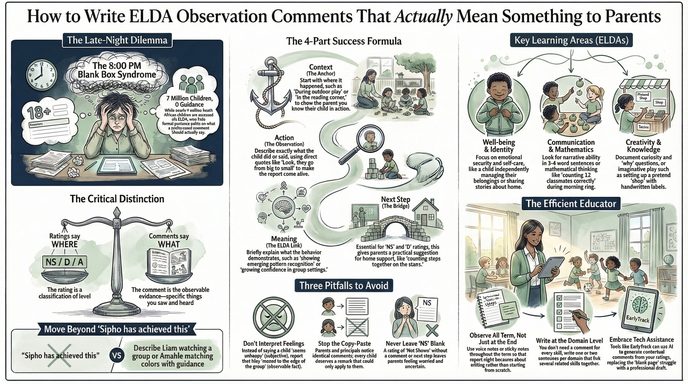
It is the last week of term. The skill ratings are done. You have worked your way through all six ELDAs, marked NS, D, or A next to skill after skill, and now there are 18 comment boxes staring back at you. It is past 8pm. You have not eaten since lunchtime. And every single comment field is blank.
This is the part nobody prepared you for. Your ECD training covered child development, the NCF, lesson planning, and developmental milestones. But the actual comment - the sentence a parent reads when they open their child's report - was left to you to figure out on your own.
You are not alone in this. Every preschool teacher in South Africa faces this moment twice a year. The South African Early Childhood Review 2024 estimates that South Africa has nearly 7 million children under the age of six. The vast majority of them are assessed using the ELDA framework. That is tens of thousands of reports generated every single term with almost no guidance on what the written comment should actually say.
This guide is that guidance. It will show you exactly how to write ELDA observation comments that are specific, meaningful, and professional - comments that tell parents something they could not learn from the tick alone, and comments that reflect the quality of teaching you are already doing every day.
What ELDA Observation Comments Are - and What They Are Not
The ELDA framework - Early Learning and Development Areas - is the South African National Curriculum Framework (NCF) for children from birth to four years. It was published by the Department of Basic Education in 2015 and updated in 2024. It organises child development into six learning areas: Well-being, Identity and Belonging, Communication, Exploring Mathematics, Creativity, and Knowledge and Understanding of the World.
Each skill within these areas is rated on a three-point scale:
- NS - Not Shown
- D - Developing
- A - Achieved
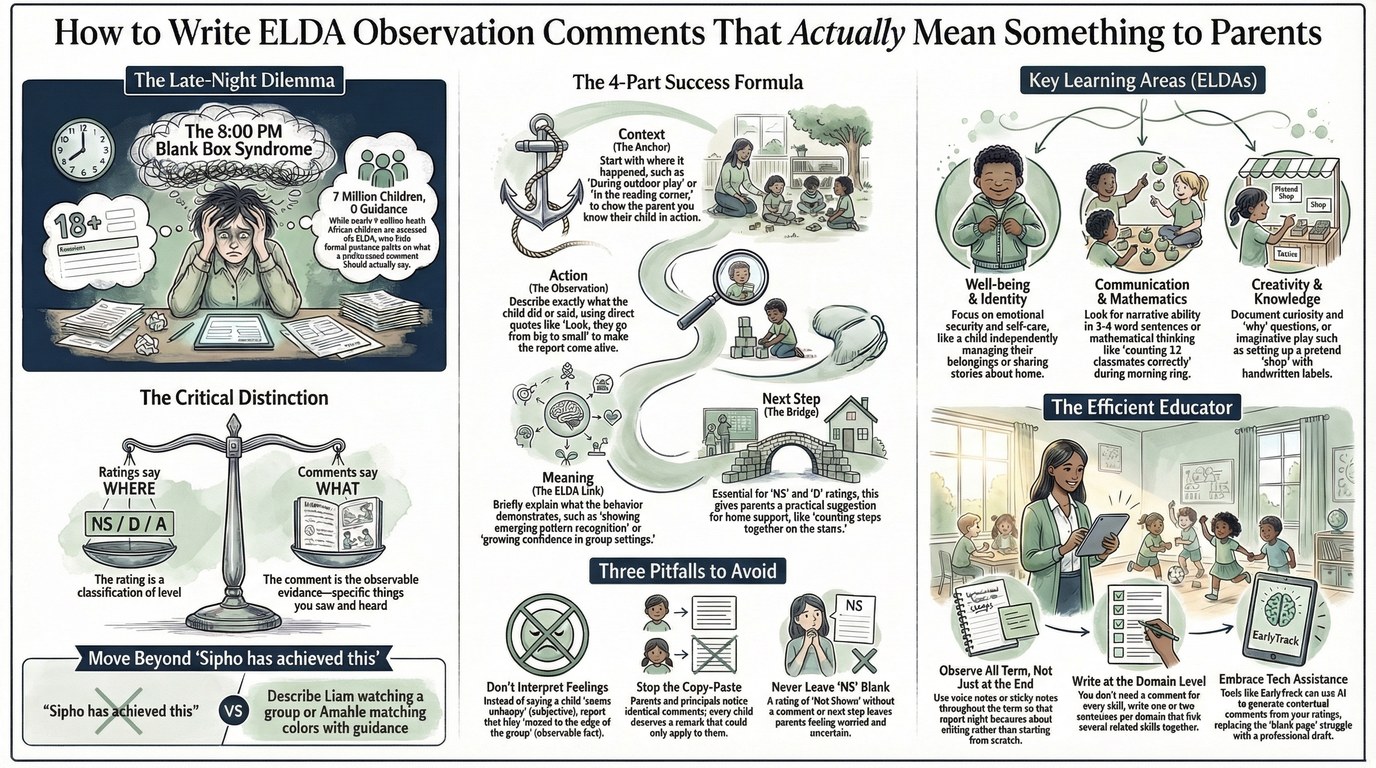
Here is the distinction that changes everything: the rating tells the parent where the child is. The observation comment tells the parent what you actually saw that led to that rating. These are two different pieces of writing, and they must be treated that way.
The NCF is clear on this point. Assessment is based on watching and listening to each child during their daily routines and play - not formal testing. The comment is therefore a record of what you observed, not a verdict you have reached.
The most common mistake? Writing the rating as the comment:
“Sipho has achieved this skill.”
That tells the parent nothing they cannot already see from the tick. The comment must add evidence. It must show your professional eye at work.
| The rating says | The comment explains |
|---|---|
| NS - Not Shown | “During group time, Liam did not yet initiate play with peers but watched with interest from the edge of the group.” |
| D - Developing | “Amahle is beginning to sort objects by colour and can match two of three groups consistently with guidance.” |
| A - Achieved | “Sipho confidently counts aloud to 10 during morning circle and correctly identifies quantities up to 5 using objects.” |
The comment in the second column tells the parent something real. It gives them a picture of their child in action. That is exactly what a good ELDA observation comment does.
The Observation-Comment Formula Every South African Preschool Teacher Can Use
You do not need to be a gifted writer to produce good ELDA comments. You need a reliable structure. Here is a simple four-part formula based on the NCF assessment guidelines and the observation methodology used by leading South African ECD organisations:
+ [What it demonstrates] + [Next step or encouragement]
Part 1 - Context
Where and when did you observe this? “During outdoor play,” “In the reading corner,” “At mealtimes,” “During a group counting activity.” This anchors the comment in real daily interaction. It signals to parents that you know their child - not from a test, but from watching them live their day.
Part 2 - What the Child Did or Said
Be specific and behavioural. Quote the child directly where you can. “Placed three blocks in a row and said ‘look, they go from big to small’” is far more powerful than “showed interest in mathematics.” The NCF explicitly instructs teachers to watch and listen - when a comment includes what a child actually said, it comes alive.
Part 3 - What It Demonstrates
Link briefly to the ELDA skill. You do not need to quote the full skill descriptor - one sentence is enough. “This shows emerging pattern recognition” or “demonstrates growing confidence in group settings.” Keep it simple. Parents do not need the technical language; they need to understand what their child's behaviour means.
Part 4 - Next Step or Encouragement
For Achieved ratings, a word of encouragement works well. For NS and D ratings, this is essential. It gives parents something to do at home and shows that you have a plan. “We will continue to support Liam with small-group play opportunities” or “You can reinforce this at home by counting steps together on the stairs” are both practical and reassuring.
Put it all together and a comment for a child rated D in Exploring Mathematics might read:
“During our morning ring activity, Amahle sorted her counting blocks into two colour groups with confidence, but needed a prompt to start a third group. This shows she is developing her sorting and classification skills. At home, you could practise sorting washing or groceries together - it makes great maths practice without feeling like a lesson.”
That is one comment. It took less than 60 seconds to write using the formula. It tells the parent exactly where their child is, what the teacher saw, and what to do next. That is a professional ELDA observation comment.
Comment Starters for Each of the Six ELDAs - With Examples
This is the section to bookmark. One ELDA at a time, with ready-to-adapt examples for each rating level. Replace [name] with the child's first name and adjust the pronoun as needed.
🎓 Writing 964 ELDA comments twice a year takes hours. EarlyTrack's AI generates contextual observation comments in English and Afrikaans - based on the child's NS, D, and A ratings - so your teachers start with a draft instead of a blank page.
See how AI comments work →
Everything in this guide, condensed into a single printable reference. The 60-second formula, NS/D/A comment starters for all six ELDAs, the five mistakes checklist, and the Comment Diagnostic Matrix - all on one page. Pin it above your desk at report time.
The Five Mistakes South African Preschool Teachers Make When Writing ELDA Comments
Knowing what not to write is just as valuable as knowing what to write. These five mistakes appear in ELDA reports across the country every term.
Five mistakes to avoid
How to Write 964 ELDA Comments Without Losing Your Mind
The honest challenge with ELDA report writing is not the formula. It is the volume. Forty-nine skills per domain, six domains, 18 to 30 children, twice a year. Here is how experienced South African preschool teachers manage it without burning out.
Observe throughout the term - not just at the end
The NCF is clear that assessment is ongoing, based on watching and listening each day during daily routines and play. Keep a small notebook, use sticky notes, or record voice notes on your phone as things happen. One observation per child per week across a ten-week term gives you 10 or more reference points per child before you sit down to write. Report night becomes editing - not starting from nothing.
Write at domain level, not skill level
You do not need a separate comment for every one of the 964 skills. Write one or two sentences per domain that reference two or three related skills together: “This term, Thandi showed strong growth across the Communication domain - she is now using 5 to 6 word sentences, retelling stories in sequence, and asking questions during our read-aloud sessions.” Three skills addressed in one flowing comment.
Start with children you know best
Writing good comments for the children who are clearest in your mind builds momentum and gets words on the page. The children who are harder to describe come easier once you are in the flow.
Use voice-to-text for observation notes
Dictating is faster than typing for most people, and voice notes can be transcribed and cleaned up later. EarlyTrack's Professional plan includes Afrikaans and English voice-to-text built directly into the assessment workflow - so teachers can record observations hands-free during the day and have them ready when report time arrives.
What a Good ELDA Comment Looks Like in the Parent Portal
When a parent opens their child's approved report in the EarlyTrack parent portal, they see the skill rating and the comment side by side. The rating is a letter. The comment is what they read.
A parent who receives a specific, warm, evidence-based comment does not just feel informed. They feel seen. They trust that the teacher knows their child. They feel confident in the school. That trust is built or lost in those two or three sentences.
A parent who receives “Shows progress in this area” for the third domain in a row starts to wonder whether anyone is actually watching their child.
Write the comment you would want to receive if it were your child.
If you want to stop writing observation comments manually entirely, EarlyTrack's AI observation comment generator drafts comments in English and Afrikaans per child per domain - drawing on the observations captured during the term. Teachers review and approve. The principal signs off. Reports go out without a single comment written from scratch.
Save hours on ELDA report writing every term
EarlyTrack's AI observation comment generator is built for the South African ELDA framework. Teachers rate each skill NS, D, or A - and EarlyTrack generates a contextual comment in English or Afrikaans. Principals review and approve before anything reaches a parent. It does not replace the teacher's knowledge of the child. It replaces the blank page at 10pm.
Start Your Free 14-Day TrialNo credit card required · Full Professional access · Standard plan from R299/month
Frequently Asked Questions About ELDA Observation Comments
What is the difference between an ELDA rating and an ELDA observation comment?
How often must South African preschools complete ELDA assessments?
What are the six ELDAs in the South African NCF?
How long should an ELDA observation comment be?
Can I write ELDA comments in Afrikaans?
What should an ELDA comment say for a child rated NS (Not Shown)?
Is there a template for ELDA observation comments?
She spent more than 30 years as a nursery school principal in South Africa before building EarlyTrack. She knows the end-of-term reporting pressure from the inside - the blank comment boxes, the ELDA framework, the parent communication gaps, and the way a single well-written comment can either reassure or alarm a family. EarlyTrack was built to fix exactly those problems, by someone who lived them.