
Most South African preschool principals are trying to manage six distinct compliance systems using tools that were never built for any of them - spreadsheets, paper registers, WhatsApp groups, and school management software designed for Grade 4 to Grade 12. This post names the six systems, explains what each one actually requires under South African law and curriculum, and shows what happens when a connected preschool management system handles all six in one place.
Key points
- Preschool management in South Africa is not generic school administration. It involves six specific systems - ELDA and Grade R assessments, DSD incident documentation, attendance and ratios, staff records, parent communication, and fee management - each with its own compliance requirement.
- Generic school management software does not cover these systems. Tools like SA-SAMS, SchoolBase, and Rise School Management are built for Grades 1 to 12. They contain no ELDA, no DSD incident module, no Bana Pele compliance structure.
- Spreadsheets and WhatsApp solve individual problems but do not connect into a system - and they leave no inspection-ready audit trail.
- The Bana Pele mass registration drive has raised the compliance stakes for every registered South African ECD centre. Silver and Gold inspections specifically check whether all six management systems are functioning.
- EarlyTrack is the only South African platform built to cover all six management systems in one connected preschool management solution - designed specifically for private registered ECD centres.
It is 4pm on a Friday. The last child has been collected. There are two outstanding DSD incident forms from this week waiting for the principal's signature. The ELDA assessment cycle closes in eleven days and three teachers have rated fewer than 60% of their class. A parent sent a WhatsApp at 2pm asking where last term's report is. The staff register for November has not been updated since the first aid certificate expired on Tuesday. And the banking for March needs to reconcile before the owner meeting on Monday morning.
This is preschool management in South Africa. Not a single one of these problems is solved by the same tool. Not a single one of them would appear in a generic school management system built for a Gauteng high school. And yet most South African preschool principals are trying to manage all six from a combination of spreadsheets, paper files, and a personal mobile phone.
The term "preschool management" gets used constantly - in software marketing, in government registration documents, in professional development courses - but almost nobody has named what it actually contains for a registered South African ECD centre. This post does exactly that.
The Six Management Systems of a Registered South African Preschool
Every registered ECD centre in South Africa - whether a two-room nursery in Centurion or a forty-learner private preschool in Cape Town - is legally required to maintain all six of the following management systems. The requirements come from three distinct sources of authority: the Children's Act norms and standards for partial care facilities, the DBE's National Curriculum Framework and CAPS, and the DSD registration requirements now administered through the Bana Pele programme.
Understanding what each system actually requires is the foundation of functional preschool management. Without this clarity, principals default to tools that address the visible surface of each problem - a spreadsheet for assessment ratings, a WhatsApp group for parent updates - without ever building a system that connects them into something that survives a DSD or DBE inspection.
System 1 - ELDA and Grade R Assessment Records
Assessment record management is the largest and most time-consuming management system in any South African preschool, and the one most likely to bring a principal to tears at 10pm on the last Tuesday of term.
ELDA - the Early Learning and Development Assessment - is the assessment framework for South African children from birth to five years. It covers 964 developmental skills across six learning and development areas: Well-being, Identity and Belonging, Communication, Exploring Mathematics, Creativity, and Knowledge and Understanding of the World. Each skill must be rated using a three-level descriptive scale (Not Yet Achieved, Partially Achieved, Achieved) for every child in every class, every reporting cycle.
Grade R assessment operates under CAPS - the Curriculum and Assessment Policy Statement - and covers 98 skills across three subjects: Home Language, Mathematics, and Life Skills. The rating scale switches to a four-level numeric system (1 to 4), the comment format changes, and the principal approval workflow becomes a formal sign-off process. Schools that run both a preschool programme and a Grade R class are managing two completely different assessment frameworks simultaneously in the same facility.
What assessment management actually requires
Functional assessment management for a South African preschool requires: a structured framework where skills are pre-loaded and correctly structured for the current term, a way to capture observations throughout the term rather than from memory at report time, an AI-assisted comment drafting capability (on Professional plan), a principal review and approval queue, branded PDF report generation, and a parent delivery system that creates a read-confirmation trail. When any of these components is missing, the process degrades - observations go unrecorded, comments get written from memory in the final week, the principal signs off on reports they have not read, and PDF generation becomes a manual design exercise on a Friday evening.
"I spent four years building the ELDA assessment grid from scratch at the start of every single term. I thought I was slow. Then I worked out that every teacher at every preschool in South Africa was doing the same thing. We were all rebuilding the same structure that already existed in the curriculum document. That is not a skill problem. That is a system problem." - Angelique, Co-Founder, EarlyTrack
For further detail on the assessment management burden specifically, see our guide to preschool teacher admin time in South Africa and the complete Grade R assessment guide.
System 2 - DSD Incident Documentation
Every registered South African ECD centre is required under the Children's Act norms and standards for partial care facilities to document every incident involving a child in their care - injuries, allergic reactions, near-misses, unauthorised collection attempts, suspected abuse, and more - using a standardised DSD incident form.
The DSD incident form has 15 sections. It requires a body map for injury location, photographic evidence documentation, and three sequential signatures - from the teacher, the principal, and the parent - in a specific order. Each form must be assigned a sequential reference number that corresponds to an incident register entry. All records must be retained for a minimum of five years and be retrievable within minutes during a DSD or DBE site inspection.
Where incident management breaks down
The breakdown pattern is consistent across South African preschools that do not have a dedicated incident management system: forms are completed from memory hours after the incident rather than at the time; the body map is left blank because the teacher was focused on the child; Section 14 (principal signature) goes unsigned for days because the principal was unavailable; Section 15 (parent signature) is never returned because the form was sent home with the child. By the time an inspector arrives, the incident file contains a collection of partially completed forms, unsigned sections, and missing photographs.
For South African preschools going through Bana Pele Silver or Gold registration, this is not a theoretical risk. Incident records are one of the specific items DSD and DBE inspectors examine during site visits. For a complete guide to the DSD incident form, see our post on DSD incident reports for South African preschools.
System 3 - Attendance and Child-to-Staff Ratios
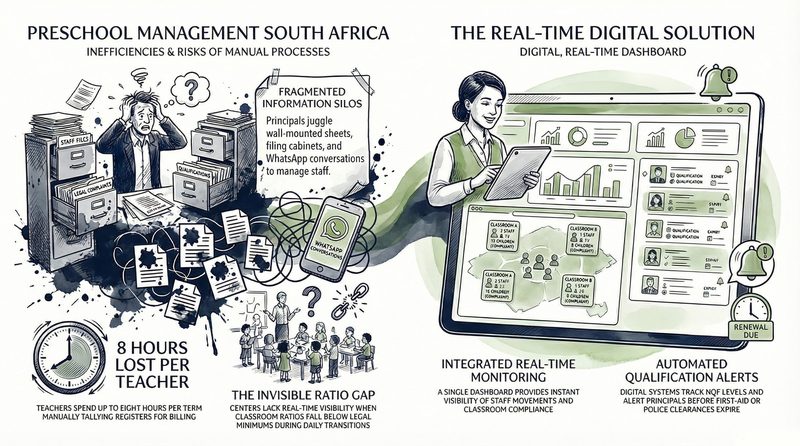
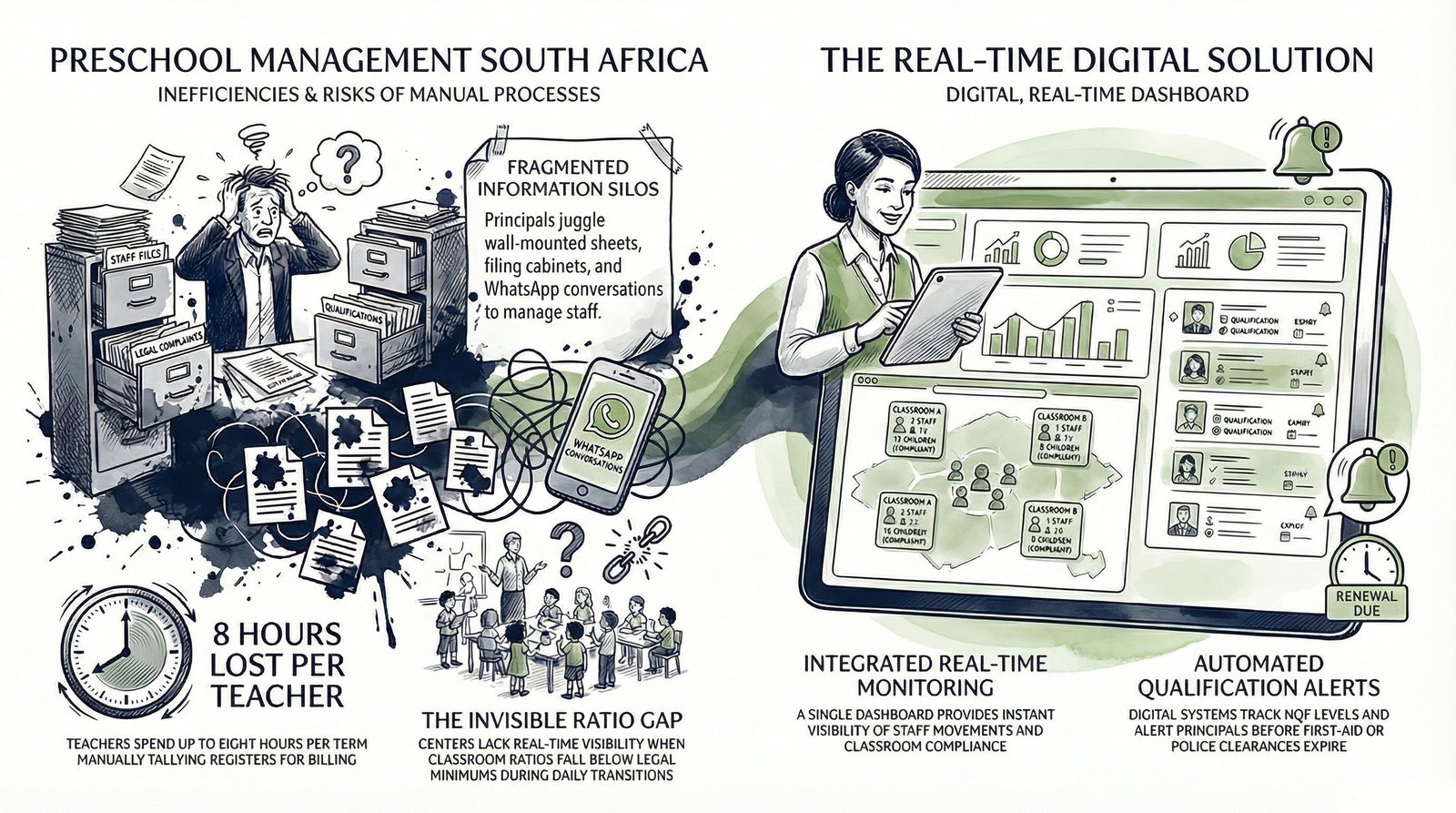
Attendance management is the most visible daily management task in any South African preschool - and the one most schools are still running on paper. A paper register is marked every morning. Absent children are followed up by phone. The register is tallied at month-end for billing and compliance purposes. Each step is manual, each step is disconnected from the next, and the accumulated time across a term is typically four to eight hours per teacher.
Child-to-staff ratios are the second component of this system, and the one with the most direct legal exposure. The Children's Act specifies the maximum number of children per practitioner by age group - with stricter ratios for babies and toddlers than for preschool-age children. A South African ECD centre that operates outside these ratios during a DSD or DBE inspection is in breach of its registration conditions.
The real-time ratio problem
The compliance challenge for most South African preschools is not that they do not know the ratios. It is that they have no way to monitor them in real time. Staff clock in late. Staff are absent unexpectedly. Staff step out of the classroom during nappy changes or outdoor supervision. In any of these moments, the ratio in a specific room may temporarily fall below the legal minimum - and nobody has visibility of this happening until something goes wrong. A connected attendance and ratio monitoring system solves this not by adding more paperwork but by making the current state visible to the principal in real time from a single dashboard. See EarlyTrack's attendance tracking for how this works in practice.
System 4 - Staff Records and Qualification Tracking
Staff record management in a South African preschool covers five categories of documentation, each with its own renewal cycle and inspection requirement: qualifications and NQF level certificates, first aid certificates (typically valid for two to three years), Child Protection Register clearances (required for every person working with children under the Children's Act), leave records and balances, and daily clock-in and attendance records for payroll and ratio compliance purposes.
Most South African preschool principals manage all five categories across a combination of a wall-mounted attendance sheet, a filing cabinet of photocopied certificates, and a WhatsApp conversation with the owner about leave approvals. There is no alert when a first aid certificate expires. There is no running leave balance. There is no way to confirm - at 8:15am on a Monday morning - that every staff member currently on the premises has a valid Child Protection Register clearance.
EarlyTrack's staff management module handles clock-in via barcode or PIN on a tablet kiosk, manages leave requests with approval workflows and running balances, tracks qualification certificates with expiry alerts, and monitors child-to-staff ratios in real time. The principal has a single dashboard instead of a filing cabinet, a wall sheet, and three different conversations.
System 5 - Parent Communication with an Audit Trail
Parent communication is the most visible management system in any South African preschool - and the one most damaged by the tool most preschools are using. WhatsApp is fast, free, and familiar. It is also unstructured, unarchived, and legally unprotected. When a parent claims they were never told about an incident, a WhatsApp message that was sent on Tuesday but not read until Thursday is not evidence of notification. When a child's assessment report needs to be delivered to a specific parent in a specific language, a class WhatsApp group is not the right tool for the job.
Parent communication management in a registered South African ECD centre must cover: assessment report delivery with read confirmation, DSD incident notification with parent acknowledgement, absence notification and follow-up, general school communication with delivery records, and the POPIA-compliant handling of child photographs and personal information. None of these requirements are met by a personal WhatsApp group.
The POPIA compliance problem most preschools are ignoring
When a child's photograph circulates in a WhatsApp group containing 30 or 40 parents - many of whom the school has never formally collected consent from - the school is potentially in breach of the Protection of Personal Information Act. When a sensitive incident notification is sent via WhatsApp rather than through a secure, access-controlled system, the school has no control over where that information goes. The question is not whether a South African preschool will eventually face a parent complaint about privacy. The question is whether the school will have a compliant communication system in place when it does. EarlyTrack's parent portal gives parents structured, access-controlled access to their own child's records - and only their own child's records.
System 6 - Fee and Billing Management
Fee management is the management system that determines whether a South African preschool survives as a business. A school that delivers excellent assessment reports, maintains perfect incident records, and employs qualified, well-managed staff will still close if its fee collection is inconsistent. And yet most South African private preschools are managing fee billing from a combination of a bank statement, a handwritten register of who has paid, and a WhatsApp message to parents who are in arrears.
Professional fee management for a South African ECD centre requires: automated monthly invoicing, a clear record of payments against each learner's account, a parent-visible balance so that disputes are resolved with reference to data rather than memory, arrears tracking with automated reminders, and a monthly reconciliation that gives the owner a clear view of revenue before any manual work is required. For a private registered preschool operating on thin margins in a competitive local market, the difference between a school that collects 92% of fees and one that collects 78% is frequently the difference between financial sustainability and crisis.
Why Generic School Management Software Fails South African Preschools
When a South African preschool principal searches for "school management software South Africa," the results are dominated by platforms built for a completely different educational context. SA-SAMS serves 85% of all South African schools - but it was built for the Department of Basic Education's Grade 1 to Grade 12 school system. SchoolBase has 20,000 users across South Africa - primarily primary and secondary schools. Rise School Management, Edupac, iSAMS - all built for, and primarily serving, the mainstream school sector.
These are not bad tools. They solve real problems for the schools they were built for. The problem is that they were not built for South African preschools. Not a single one of them contains an ELDA assessment framework. Not a single one has a DSD incident form with body map and three-signature chain. Not a single one understands the Bana Pele Bronze-Silver-Gold registration structure. Not a single one is aware that a Grade R class requires a different rating scale, a different comment format, and a different approval workflow than a Grade 4 class.
| Management system | EarlyTrack | Spreadsheets | Generic SA school software | Free ECD app | |
|---|---|---|---|---|---|
| ELDA assessment (964 skills) | ✓ | Manual rebuild each term | ✗ | ✗ | Basic only |
| Grade R CAPS assessment (98 skills) | ✓ | Manual rebuild | ✗ | ✗ | ✗ |
| AI comment generation (EN + AF) | ✓ | ✗ | ✗ | ✗ | ✗ |
| DSD incident form (15 sections) | ✓ | Paper only | ✗ | ✗ | ✗ |
| Three-signature chain (digital) | ✓ | ✗ | ✗ | ✗ | ✗ |
| Attendance with ratio monitoring | ✓ | Register only | ✗ | Attendance only | Attendance only |
| Staff qualification expiry alerts | ✓ | Manual calendar | ✗ | Partial | Basic |
| Parent portal with read-confirmation | ✓ | ✗ | No confirmation | Partial | Basic |
| Bana Pele inspection-ready records | ✓ | ✗ | ✗ | ✗ | Partial |
| Built specifically for SA private preschools | ✓ | ✗ | ✗ | ✗ | ✗ |
The free Grow ECD app is a genuine tool for the South African informal and community ECD sector - it was designed for centres navigating registration for the first time and provides real value in that context. But a private registered preschool with ELDA cycles, Grade R CAPS assessments, DSD incident obligations, and POPIA-compliant parent communication needs is operating in a different context, and needs a different system.
What DBE and DSD Inspectors Actually Check at a South African Preschool
The Bana Pele ECD registration drive has changed the stakes for preschool management in South Africa. Schools moving from Bronze to Silver registration face a physical site inspection where inspectors examine specific documentation. Understanding what they are looking for is the fastest way to understand what a functional preschool management system must actually produce.
Documentation inspectors check during Bana Pele Silver registration
A school running all six management systems on disconnected tools - spreadsheets, paper files, WhatsApp - can technically produce most of these documents for an inspector. The question is whether it can produce them quickly, completely, and without gaps. A school with 47 incomplete incident forms and no sequential register is not in a stronger position because its gaps are on paper rather than in a system. It is in a worse position, because the gaps are harder to find and harder to fix.
Everything in this guide turned into tools you can use this term. The Six-System Preschool Management Checklist, DSD Incident Documentation Checklist, 10-Week Term-End Countdown Planner, printable Weekly Observation Log, Parent Communication Templates, and the Annual Admin Calendar. Pin it above your desk at the start of every term.
EarlyTrack is the only South African preschool management system that covers all six management systems in one connected platform - ELDA and Grade R assessments, DSD incident reporting, attendance and ratio monitoring, staff records, parent portal, and fee management - built specifically for registered South African ECD centres.
Start Your Free 14-Day Trial →What a Connected Preschool Management Week Looks Like
The difference between a disconnected preschool management system and a connected one is not the number of tasks - the tasks are the same. The difference is whether each task feeds into the next, or requires a teacher to rebuild context from scratch each time. The table below shows the same week in both systems.
| Management task | Disconnected (spreadsheets, paper, WhatsApp) | Connected (EarlyTrack) |
|---|---|---|
| Monday morning attendance | Paper register, phone calls for absences, monthly manual tally | Digital register, parent notified automatically when child absent past cutoff, ratio updated in real time |
| Tuesday - incident in baby room | Paper DSD form from the drawer, completed from memory, waiting for principal signature, form goes home with child | Digital form opened immediately, 15 sections complete, body map marked, principal reviews in queue, parent acknowledges in portal |
| Wednesday - ELDA observation | Post-it note on the teacher's desk, transferred to spreadsheet on Thursday evening | Voice note dictated during outdoor play, transcribed and linked to ELDA domain and learner profile automatically |
| Thursday - parent requests last term's report | Teacher emails the owner to find the PDF, owner searches the laptop, PDF sent via WhatsApp | Parent logs into the parent portal and downloads the report directly - no teacher involvement required |
| Friday - staff first aid cert expired | Owner discovers this during annual file audit, three months after the expiry | Alert sent to principal 30 days before expiry, follow-up alert on the day - no discovery required |
| End of term - assessment reporting | 20 to 35 hours per teacher rebuilding grids, writing comments from memory, chasing principal signatures, generating PDFs manually | Skills pre-loaded, observations captured throughout the term, AI drafts comments, principal approves in queue, PDFs generated and delivered automatically |
How EarlyTrack Handles All Six Preschool Management Systems
EarlyTrack was built from the inside of South African private preschool management - not adapted from a generic childcare platform or repurposed from a school ERP. Every feature in the platform exists because it solves a specific problem that appears in the South African private registered preschool context: the ELDA assessment cycle, the DSD incident form, the Bana Pele compliance structure, the CAPS Grade R rating scale, the Afrikaans parent who needs their child's report in their home language.
All six management systems in one connected platform
Every management system required by a registered South African ECD centre - from ELDA and Grade R assessments to DSD incident documentation, attendance monitoring, staff records, parent communication, and fee management - connected in a single platform that keeps all six in sync.
Which plan covers which systems
EarlyTrack's Standard plan (R299/month) includes ELDA and Grade R assessments, the DSD incident reporting module, attendance tracking, the parent portal, staff records, and branded PDF report generation. The Professional plan (R499/month) adds AI-generated comment drafts in English and Afrikaans, voice-to-text observation capture during the school day, and advanced analytics across all six management systems. Both plans are designed for South African registered private ECD centres and a new school gets one 14-day free trial (one per owner and cellphone number) with full Professional access - no credit card required.
For Afrikaans-medium South African preschools, all six management systems are available in Afrikaans - interface, ELDA and Grade R skill descriptions, AI comment drafts, PDF reports, and parent portal communications. Learn more on the EarlyTrack Afrikaans page.
Schools that run ELDA assessments for younger classes and Grade R for their reception class manage both frameworks inside the same EarlyTrack platform - same principal approval workflow, same parent portal, same PDF system. For further reading on how to manage the full admin burden across a South African preschool term, see our complete guide.
Ready to connect all six management systems in one platform built for South African preschools?
ELDA and Grade R assessments pre-loaded. DSD incident reporting with all 15 sections and digital signatures. Real-time attendance and ratio monitoring. Staff records with qualification expiry alerts. Secure parent portal with read-confirmation. All built specifically for registered South African ECD centres.
Start Your Free 14-Day TrialExplore All Six Management Systems
No credit card required · Full Professional access · Standard plan from R299/month · Cancel any time
Frequently Asked Questions About Preschool Management in South Africa
What does preschool management actually involve for a registered South African ECD centre?
Why doesn't generic school management software work for South African preschools?
What is the hardest part of managing a South African preschool?
What software is available for preschool management in South Africa?
What does the Bana Pele registration drive mean for preschool management?
How much does preschool management software cost in South Africa?
What records must a South African preschool keep for DBE and DSD inspections?
Does EarlyTrack support Afrikaans-medium South African preschools?
She spent more than 30 years as a nursery school principal in South Africa before building EarlyTrack. She managed ELDA assessment cycles through the introduction of the NCF, navigated multiple DSD registration processes before Bana Pele existed, trained teachers who had never completed a preschool management system in their lives, and experienced first-hand what it costs a principal to run six management systems on six different tools. EarlyTrack was built to be the system she spent 30 years wishing she had. Explore all six management systems at earlytrack.co.za/features.