
South African preschool teachers carry one of the heaviest admin loads in the education sector - yet almost none of it has been formally measured. This post breaks it down task by task: ELDA and Grade R report writing, daily attendance and follow-up, DSD incident documentation, staff records, and parent communication. It gives honest time estimates for each task, explains why the load compounds at term-end, and shows what the same work looks like when a connected system handles the repetitive parts automatically.
Key points
- Admin is the biggest source of stress for more than two-thirds of South African teachers - not classroom management, not learner behaviour. Admin.
- End-of-term ELDA and Grade R report writing is the single largest hidden time cost - rebuilding grids from scratch, writing hundreds of individual comments, chasing principal sign-offs.
- Five tasks account for the majority of preschool admin time in South Africa: report writing, attendance management, incident documentation, staff records, and parent communication.
- The load is not random - it is structural. It is the result of using tools that store information but do not run processes.
- EarlyTrack replaces all five with workflows that enforce completeness, generate AI comment drafts in English and Afrikaans, and automate the repetitive steps - so teachers spend time observing children, not managing paperwork.
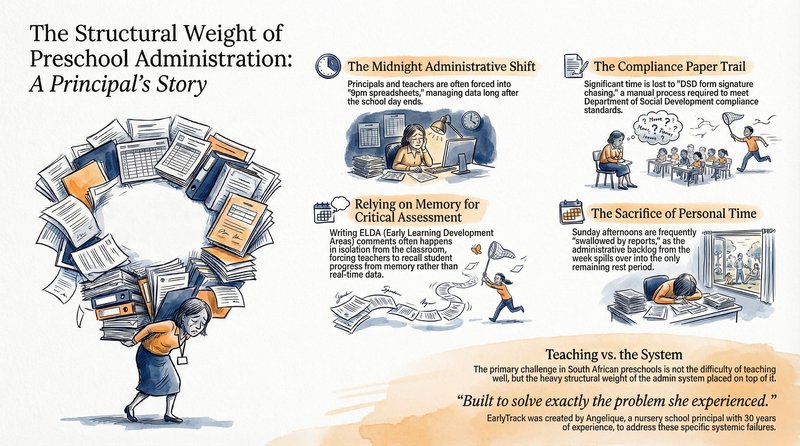
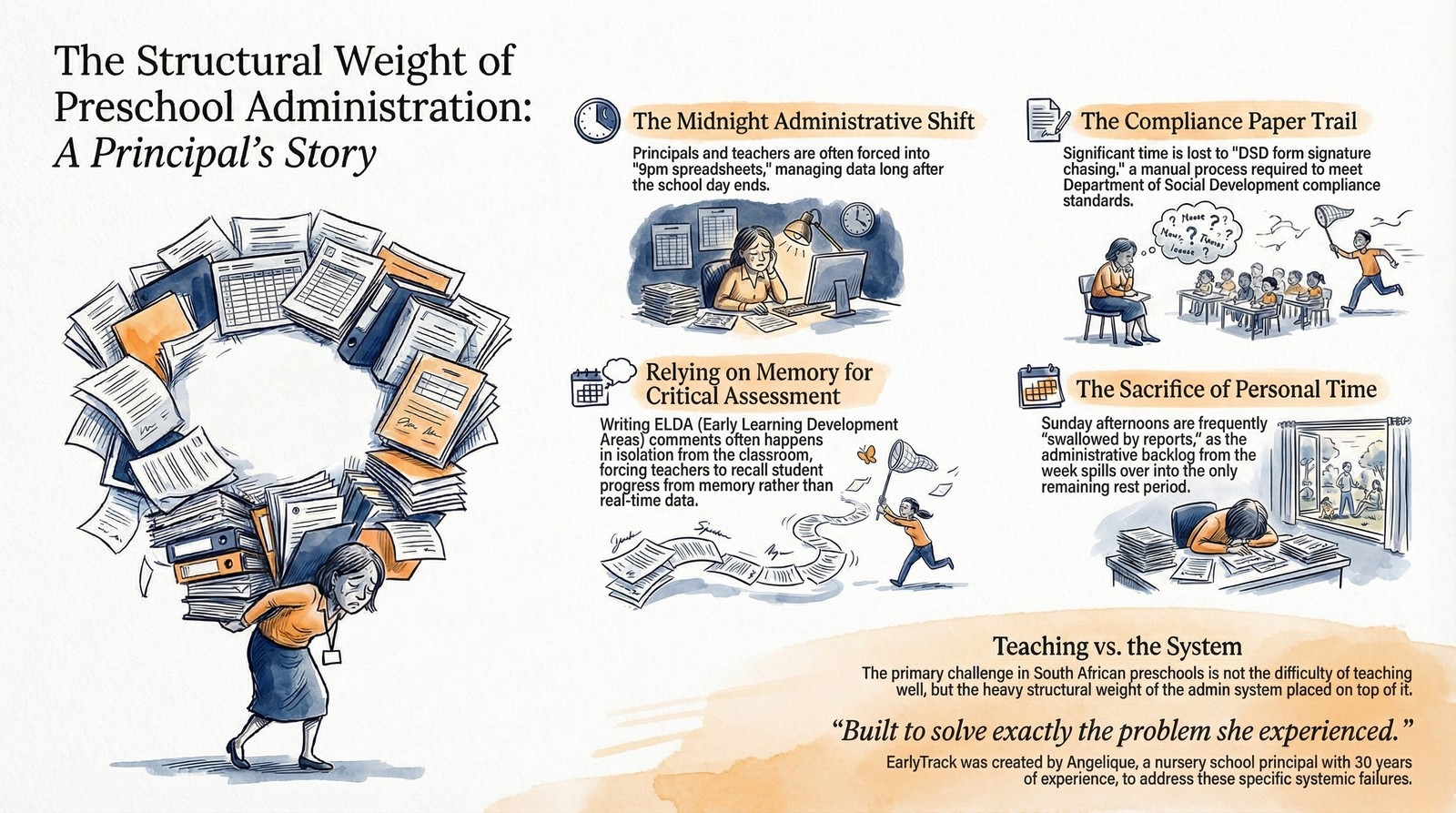
It is 9:15pm on a Wednesday. The children are in bed. The kitchen is quiet. The laptop is open on the dining room table with a spreadsheet that has 26 columns and 964 rows - one for each ELDA skill, one for each child in the class.
The teacher has been at school since 7am. She observed, managed, comforted, redirected, and documented all day. And now the actual admin starts.
There are six school days left before ELDA reports go home to parents. Roughly half the skills have been rated for roughly half the class. The AI comment generator does not exist in the current system. The principal has not seen any of these reports yet. And the attendance register for Monday still has three children marked absent who were actually present.
This is the standard term-end week for a South African preschool teacher. Not a bad one. A standard one.
Every South African preschool teacher knows this moment. What almost nobody has done is count the hours. This post does exactly that.
End-of-Term ELDA and Grade R Report Writing
This is the dominant one. Nothing else in the South African preschool admin calendar comes close.
ELDA covers 964 skills across five age brackets and six developmental domains. Grade R covers 98 skills across Home Language, Mathematics, and Life Skills. Every South African preschool teacher managing either framework typically does the following at the start of every term: opens a curriculum document, recopies the skill list, rebuilds an Excel grid, formats it, adapts it for the term's subsections, and shares it with other teachers. Then does it again next term.
That is a setup cost of one to two hours before a single child has been assessed.
Then the rating begins. A teacher with 20 learners working through 964 ELDA skills is making roughly 19,280 rating decisions per term - one per skill, per child. Even at 10 seconds per rating, that is over 53 hours of focused work. In practice it takes longer: navigating spreadsheet rows, cross-referencing observations, and the fact that each ELDA skill requires genuine reflection, not a checkbox.
Then the comment writing begins. For a class of 20 learners, a Grade R teacher writes at minimum 60 report comments - three subjects per child, two to four sentences each. A teacher writing from scratch, without observation notes and without AI-drafted suggestions, typically needs 20 to 40 minutes per child. For 20 children, that is between 6 and 13 hours of comment writing alone.
"I spent four years thinking I was a slow writer. That I needed to work faster, be more organised, get up earlier. Then I realised the problem was not me - it was that I was building the entire reporting system from scratch every single term, writing every single comment from a blank page. That is not slow. That is structural." - Angelique, Co-Founder, EarlyTrack
This is the week that does not end. This is the Sunday that disappears. This is why South African preschool teachers describe the last two weeks of every term as the hardest fortnight of the year. For further context on how much goes into Grade R assessment specifically, see our complete Grade R assessment guide.
Daily Attendance and Absence Follow-Up
Attendance sounds simple. It is the most persistent daily admin task a South African preschool teacher has.
In most South African preschools, a teacher marks a paper register every morning. If a child is absent, someone - the teacher or the office - calls the parent to confirm. If the parent does not answer, the call is repeated. The teacher updates the register at the end of the day. At month end, the register is tallied for billing, subsidy, or compliance purposes.
Each individual step is short. Across a 10-week term with 20 learners, the accumulated time for daily register completion, absence calls, callback logs, and monthly summaries is typically four to eight hours per teacher. Small in isolation - but done entirely by hand, entirely outside teaching time, and entirely without any system to remind, track, or automate the steps that could be automated.
DSD Incident Documentation and Signature Chasing
The DSD 2022 incident form has 15 sections. It requires a body map for injury location. It requires photo evidence. It requires dated and witnessed signatures from the teacher, the principal, and the parent. It requires a numbered record that can be retrieved during a DSD or DBE inspection.
On paper, this form takes 20 to 40 minutes to complete properly - per incident. Then the signature process begins. The teacher signs. The form goes to the principal. The principal reviews and signs. The form goes home with the child. The parent signs and returns it. The school files a copy.
In practice: the principal is not immediately available. The parent sometimes forgets to return the signed form. The school chases the signed copy for days. The original is eventually filed - somewhere - and retrievable only if someone remembers which folder.
South African preschools with busy baby rooms or large playgrounds can process three to five incidents per week. At 20 to 40 minutes per incident plus signature follow-up, a principal can spend three to five hours per week on incident documentation alone during peak periods. For schools operating under DSD registration requirements, incomplete or missing incident records are exactly the kind of compliance gap flagged during inspections.
Staff Records, Leave, and Qualification Tracking
Most South African preschools manage staff admin across several different notebooks and spreadsheets: one for attendance sign-in, one for leave requests and balances, one for qualification certificates and expiry dates, sometimes a separate list for the daily duty roster.
A principal checking whether a staff member's first aid certificate is still valid has to open a spreadsheet, find the row, check the date, and note whether a renewal is overdue. A staff member requesting leave fills in a form that goes to the principal's inbox - or WhatsApp - and receives approval by message. There is no running leave balance. There is no alert when a qualification expires. The principal is the system.
EarlyTrack's staff management module handles clock-in via barcode or PIN on a tablet kiosk, manages leave requests with approval workflows and running balances, tracks qualification certificates with expiry alerts, and monitors child-to-staff ratios in real time. The principal has a single dashboard instead of three notebooks.
Parent Communication Without a Trail
WhatsApp is how most South African preschools communicate with parents. It is fast, free, and everyone already uses it. It is also completely unstructured - no delivery confirmation per parent, no record of what was shared and when, no privacy control over sensitive information, and no way to confirm that the incident report sent on Tuesday was actually read by the parent on Thursday.
The time cost is not just in sending messages. It is in the follow-up. Who did not receive the report? Who has not acknowledged the incident notification? Who asked a question in the group chat that the teacher now needs to answer individually, with no reference to prior context?
A teacher managing parent communication through WhatsApp typically spends two to three hours per week on messages, callbacks, and re-sends - time that sits entirely outside teaching hours. During report week, this doubles or trebles as parents ask about ratings, request meetings, and respond to low scores without context.
EarlyTrack's parent portal gives parents structured access to assessment reports, attendance history, incident records, and home learning activities in one place. Sensitive information never sits in a chat group. The school has a complete communication trail. The teacher stops re-sending and chasing.
How Many Hours Does South African Preschool Admin Actually Add Up To?
These are conservative estimates for a South African preschool teacher with a class of 20 learners, across one full term.
| Admin task | Hours per term (typical) | Notes |
|---|---|---|
| ELDA or Grade R report writing | 20 to 35 hours | Grid rebuild, skill rating, comment writing, principal revision cycles |
| Daily attendance and follow-up | 4 to 8 hours | Register, absence calls, monthly summaries |
| DSD incident documentation | 3 to 8 hours | Varies significantly by school size and age group |
| Staff records and leave management | 2 to 4 hours | Higher for principals managing all staff |
| Parent communication | 8 to 12 hours | WhatsApp follow-up, re-sends, callbacks |
| Total | 37 to 67 hours | Across one teacher, one class, one term |
A preschool with three teachers working through a full term is collectively spending somewhere between 110 and 200 hours on admin - for a single term. Across a four-term South African school year, that is between 440 and 800 collective staff hours spent not teaching.
Why the Admin Load Gets Worse at Term-End - Not Better
The tasks above are not evenly distributed. Most of them accumulate quietly throughout the term and then arrive simultaneously in the final two weeks. That is why the end of every South African preschool term feels like a crisis - not because teachers are disorganised, but because the structure of manual systems creates a compression point.
The ELDA grid that was not set up in Week 1 has to be built under pressure in Week 9. The observation notes that were not written during the term have to be reconstructed from memory at 9pm. The incident forms that were filed informally now have to be found and checked before a DSD compliance visit. The attendance records that were not tallied weekly now require three hours of manual calculation in the last days of term.
Every manual system produces this pattern. And every South African preschool teacher who has lived through it has made the same resolution on the last day of each term: next term I will start earlier, be more organised, write notes every day.
The resolution is not wrong. The system is wrong.
🕐 South African preschool teachers spend an estimated 37 to 67 hours per term on admin tasks unrelated to teaching. Across a four-term year, that is between 150 and 270 hours - the equivalent of six to eleven full working weeks - spent on paperwork, spreadsheets, signature chasing, and message follow-up.
See what a connected system changes →
Everything in this guide in one printable PDF. The Admin Audit Worksheet, 10-Week Term-End Countdown Planner, printable Weekly Observation Log, Five Admin Task Checklists, five Parent Communication Templates, the DSD Incident Documentation Checklist, and the Annual Admin Calendar. Pin it above your desk at the start of every term.
What the Admin Load Actually Costs South African Preschools
Nobody adds up the hidden cost of manual admin in a South African preschool. It is accepted as normal - the nights, the weekends, the scramble - because everyone in the sector has always worked this way. But the cost is real, and it shows up in three places.
Teacher burnout and retention
More than two-thirds of South African teachers say administrative work is their biggest professional stressor. When a teacher leaves a South African preschool, it is rarely because she stopped caring about children. It is because the admin never stops. A teacher who arrives at 7am, teaches all day, and then opens a laptop at 8pm to complete reports has no margin left. The school loses institutional knowledge, trained staff, and the relationships that parents and children depend on - because the system demanded too much.
Report quality and parent trust
A teacher writing ELDA comments from memory under pressure at 11pm produces a different report than a teacher writing from two weeks of structured observation notes. The child described in the first report is a composite impression. The child described in the second is the actual child, in the actual classroom, during this term. Parents can tell the difference. And the parent who receives three terms of generic comments will eventually ask whether the teacher actually knows their child.
Compliance risk
South African preschools operating under DSD registration requirements need retrievable, dated, complete incident records. Schools with ELDA and Grade R programmes need assessment evidence that will stand up to a DBE inspection. Spreadsheets and paper forms can store information - but they cannot enforce completeness, sequence, or signature collection. The principal who has to reconstruct three months of incident records the morning before an inspection is managing a system failure, not a filing problem.
What the Same Admin Week Looks Like With a Connected System
The five tasks do not disappear. Attendance must still be taken. Assessments must still be completed. Incidents must still be documented. Staff still need leave approved. Parents still need communication. What changes is the structure of the work.
| Task | ✘ Manual system | ✔ Connected system (EarlyTrack) |
|---|---|---|
| ELDA report writing | Rebuild Excel grid every term. Rate 964 skills across spreadsheet rows. Write all comments from scratch. Email to principal for review. Revise, reprint. | Skills pre-loaded from Day 1. Rate using structured digital form. AI generates comment drafts in English or Afrikaans. Principal approves on screen. Branded PDF auto-generated and sent to parent portal. |
| Attendance | Paper register every morning. Manual calls for absences. End-of-month tally. No real-time visibility for principal. | Digital register. Auto-absent marking after configurable cutoff. Parent notification sent automatically. Principal sees all classes in real time. |
| Incident records | 15-section paper form. Photo attachments in a folder. Signature chasing across multiple days. File somewhere, hope it's findable. | Digital form with all 15 sections, body map, photo upload. Sequential digital signatures. Parent acknowledgement tracked in portal. Auto-numbered. Retrievable in seconds. |
| Staff records | WhatsApp leave requests. Notebook leave balances. Manual expiry date reminders. Separate clock-in sheet. | Digital leave requests with running balances. Qualification alerts before expiry. Kiosk clock-in with timestamps. Real-time ratio monitoring. |
| Parent communication | WhatsApp groups. No delivery trail. Re-sends. Sensitive information on personal devices. | Secure parent portal. All reports, attendance, and incidents in one place. Parents acknowledge directly. Full communication trail. Nothing sensitive in a chat group. |
How EarlyTrack Handles the Five Time Thieves
EarlyTrack was built specifically for South African preschools, ECD centres, and Grade R schools - not adapted from a global product, not repurposed from a primary school tool. Built for the specific combination of ELDA, Grade R, DSD 2022 compliance, bilingual English and Afrikaans, and the operational reality of a South African early learning centre.
What EarlyTrack covers across the five admin tasks
One connected system replacing all five manual time sinks - in one platform, in English and Afrikaans.
How the end-of-term week changes
- Assessment forms are ready from Day 1. No grid to rebuild. No spreadsheet to format. ELDA and Grade R frameworks load with the correct term structure automatically. The teacher opens a form and starts rating immediately.
- Observations captured throughout the term. Voice-to-text on Professional plan lets teachers record a 10-second observation hands-free during class. Transcribed and linked to the correct ELDA or Grade R skill automatically.
- AI generates comment drafts from the ratings. Teachers review and edit - not write from scratch. The same 20 children take two hours instead of two days.
- Principal approves on screen. One queue. One click per approval. Written change requests visible to the teacher immediately. Nothing reaches parents without sign-off.
- Branded PDF generated automatically. School logo, student details, domain ratings, observation comments. Delivered to the parent portal with email notification. No formatting work.
- Everything is retrievable. Incident records, attendance history, assessment evidence - all timestamped, all structured, all findable in seconds.
Both the Standard and Professional plans include assessments, attendance, incidents, staff management, and the parent portal. AI comment generation in English and Afrikaans, voice-to-text observations, and bulk AI generation across a full class are Professional plan features. Learn more on the EarlyTrack Afrikaans page for full bilingual support details.
Ready to reclaim the evenings and weekends that report writing takes away?
EarlyTrack replaces the five manual admin time sinks with one connected system - ELDA and Grade R frameworks pre-loaded, AI comment drafts in English and Afrikaans, DSD-compliant incident forms, digital attendance, and a secure parent portal. Standard plan from R299/month.
Start Your Free 14-Day TrialNo credit card required · Full Professional access · Standard plan from R299/month · Cancel any time
Frequently Asked Questions About Preschool Teacher Admin Time in South Africa
How many hours does a South African preschool teacher spend on admin per week?
Why does end-of-term ELDA report writing take so long in South Africa?
Is it normal for South African preschool teachers to work evenings and weekends?
What is the biggest single time saving a South African preschool can make on admin?
Does EarlyTrack work for smaller South African preschools with only one or two classes?
Can reducing admin help with teacher retention in South African preschools?
Does EarlyTrack support Afrikaans for South African preschools?
She spent more than 30 years as a nursery school principal in South Africa before building EarlyTrack. She has lived every part of the admin cycle described in this post - the 9pm spreadsheets, the ELDA comment writing from memory, the DSD form signature chasing, the Sunday afternoon swallowed by reports. EarlyTrack was built to solve exactly the problem she experienced for three decades: not the difficulty of knowing children and teaching well, but the structural weight of the admin system placed on top of it.