
What this guide covers
- Why most preschool appraisals fail, and what the teacher actually experiences
- What changed in September 2025, and why it matters to a small school
- The four things a fair appraisal must have, in plain language
- The six areas to appraise a preschool teacher on, written for an ECD classroom
- Who should score, and why blind scoring changes everything
- The rating scale that works, and the three biases that ruin scores
- A four term appraisal cycle you can actually keep up with
- The feedback conversation, with words you can borrow
- What to do when a score is low, and how to write an improvement plan
- POPIA and staff records, the part almost every school gets wrong
- A free Teacher Assessment Toolkit you can print and use this term
Why most preschool teacher appraisals fail
Picture the usual version. It is late in the fourth term. The principal prints a form she found online, fills it in during a quiet twenty minutes, and calls each teacher in. The teacher sits down, hears a set of scores she had no part in, signs at the bottom, and goes back to her class. The form goes in a folder.
Nothing about that is useful. The teacher learned nothing she can act on. The principal has one opinion written down and no evidence behind it. And if that teacher is still struggling in March, the school has nothing to point to except a page of numbers she did not agree with.
The problem is not that principals are careless. It is that the tool is wrong. A single form, filled in by one person, once a year, cannot carry the weight schools ask it to carry.
"She only remembers the bad week in October. She was never in my class. I had no chance to say anything before the scores were already written."
"I knew what I was being measured on from the start of the year. I scored myself first. We compared, we talked, and we agreed what I will work on next term."
That second version is not harder to run. It is just built differently. The rest of this guide is how to build it.
September 2025 changed the rules for small schools
On 4 September 2025 a new Code of Good Practice: Dismissal was published in the Government Gazette. It replaced the old Schedule 8 to the Labour Relations Act. If you run a small preschool, two parts of it matter to you.
First, the Code now tells anyone judging fairness to consider the circumstances a small business operates in. The lawmakers accepted that a school with nine staff does not have an HR department, a labour lawyer on call, or time for a formal enquiry over every issue. Simpler, less formal processes are now expected to be acceptable, as long as they are still fair.
Second, the strict warning requirement fell away. Under the old Code you generally had to tell a teacher in writing that she might be dismissed if her performance did not improve. That is no longer a hard requirement. She must still be given a chance to explain herself before any decision is made.
Read those two changes together and it is easy to draw the wrong conclusion. The Code did not make appraisal less important. It made it more important. The formality relaxed. The need to show that you gave the teacher evaluation, guidance and a real chance to improve did not. That evidence has to come from somewhere, and a scorecard with two signatures on it is the cheapest, calmest place to get it.
A principal who has two signed appraisals and a written improvement plan is in a completely different position from one who has a folder of photocopied forms. The first has a record. The second has paper.
You can read the current Code on the CCMA website.
The four things a fair appraisal must have
Strip away the forms and the jargon and a fair teacher appraisal comes down to four things. Miss any one of them and the whole thing wobbles.
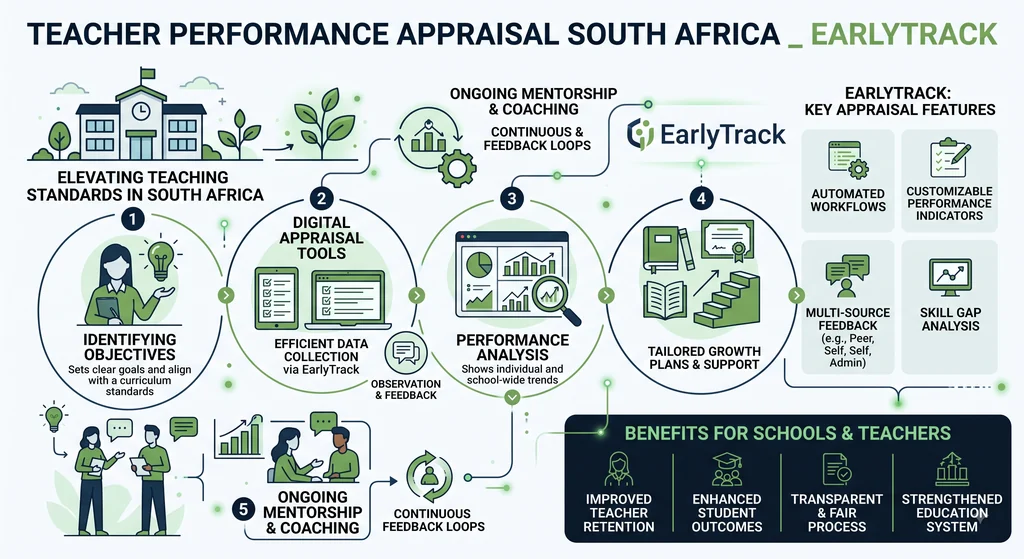
A teacher cannot be marked down for something nobody told her about. Hand out the scorecard at the start of the year, not at the review. This single step removes most of the arguments.
Not a feeling. Not one incident in June. A score should point to something real: a classroom visit, the state of her observation records, a parent complaint, an attendance pattern.
She scores herself before she sees your scores. She speaks in the meeting. If she disagrees, that disagreement is written down next to the score, not argued away.
A dated document with her signature and yours. Not proof she agreed. Proof the conversation happened, on that day, about those things.
Everything else in this guide is detail hanging off those four points.
The six areas to appraise a preschool teacher on
Generic staff appraisal forms ask about "initiative" and "communication skills". Those words mean nothing in a room with twenty three year olds in it. Score a preschool teacher on what a preschool teacher actually does.
Does she plan ahead? Does the day flow, or is it chaos between activities? Are the activities right for the age group? Is her theme work more than a laminated border on a wall?
Head counts. Eyes on the class at all times. Gate and sign out discipline. Reporting an injury the same day. This area is not negotiable and should be weighted highest.
Are her ELDA observations current, or written in a panic before reports go out? Do her comments describe the child, or repeat the same three phrases for everyone?
Does she answer parents the same day? Does she raise a concern early rather than letting it surface at the parent meeting? Does she stay calm with a difficult parent?
Timekeeping. Notice given for leave. Whether she covers for a colleague without being asked. Whether the staff room is easier or harder when she walks in.
Did she do what she said she would do after her last appraisal? Has she done any training this year? For SACE registered staff, is she keeping up her CPTD points?
Under each area, write three to five short statements a teacher can picture herself doing. "Keeps observation notes up to date each week" is scoreable. "Demonstrates commitment to assessment" is not.
Do not use more than six areas. A scorecard with fourteen sections gets rushed, and a rushed scorecard is worse than a short honest one.
Three people should score, and none should see the others
One person scoring alone is the root of nearly every unfair appraisal. Not because principals are unfair, but because one person only sees part of the picture. You see the classroom during your walk past. The teacher next door sees how she is at half past two on a Friday. The teacher herself sees all of it.
So take three scores on the same scorecard.
You, or the head teacher who works closest to her. This is the formal view, based on what the school has observed and recorded through the year.
She scores herself on the same statements, before she sees anything else. This is the score that makes the meeting a conversation instead of a verdict.
One colleague who works alongside her. Optional but powerful. Keep it to one peer and make it clear this is about growth, not about ranking staff against each other.
Score blind. Nobody sees anyone else's score until all three are in. The moment a teacher can see that the principal gave her a 2, she will not score herself a 4, and you have lost the most useful thing in the whole process: the gap between how she sees her work and how the school sees it.
That gap is where the real conversation lives. A teacher who scores herself far higher than you did needs to understand the standard. A teacher who scores herself far lower than you did is usually anxious and needs to hear that she is doing well. Both are things you would never have learned from a form you filled in alone.
Use four points, not five
Five point scales feel gentler. They are also nearly useless, because almost everyone lands on a 3. Researchers call this central tendency, and it is one of the oldest problems in performance appraisal. A four point scale removes the middle and forces a decision: is this at standard, or is it not?
| Score | What it means | What you do about it |
|---|---|---|
| 4 · Strong | Consistently above what the school expects. Others could learn from her here. | Say so out loud. Ask her to mentor someone. |
| 3 · Solid | Meets the standard. This is a good score, not a mediocre one. | Confirm it and move on. |
| 2 · Developing | Not yet at standard, but close, and improving with support. | Agree one specific action for next term. |
| 1 · Below standard | Falls short in a way that affects children, parents or the team. | Written improvement plan with a date to review. |
Three biases will wreck your scores if you let them. Name them out loud before you start scoring and you will catch yourself.
- The halo effect. She is warm and the parents love her, so she scores 4 on everything, including her paperwork, which is two months behind.
- Central tendency. Scoring everyone in the middle to avoid a hard conversation. It protects you today and helps nobody, least of all her.
- Recency bias. Scoring the last six weeks instead of the year. This is the single biggest reason teachers feel appraisals are unfair.
The cure for recency bias is not willpower. It is notes. If you only write things down in November, you will only remember November.
A four term cycle you can actually keep up with
Two full appraisals a year is the sweet spot for a small school. Less than that and the record is too thin. More than that and it becomes a chore everyone resents and then quietly abandons.
-
1
Term 1
Set the standard
Hand every teacher the scorecard. Walk through it in a staff meeting. Nobody is scored yet. Everyone knows what the year will be measured on.
-
2
Term 2
First full appraisal
School score, self score, peer score. Feedback meeting. Two or three goals agreed and written down. Both parties sign.
-
3
Term 3
Quick check in
Fifteen minutes per teacher. No scoring. Just: how are the goals going, and what do you need from me? This is where the year is actually won.
-
4
Term 4
Second full appraisal
Score again on the same scorecard. Compare to term two. Talk about the direction of travel, not just the number. Sign and file.
The term three check in is the part schools skip, and it is the part that makes the term four appraisal painless. A teacher who has heard about a problem in August is never blindsided in November.
The feedback conversation, word for word
Most principals dread this meeting. It goes better when you follow the same shape every time and let her talk first.
"Thanks for making time. This is not a test. I want us to end up with two or three things you will focus on next term. You go first."
"Take me through how you scored yourself. Where do you think you are strongest? Where do you know you are not where you want to be?"
"Here is how the school scored you. We agree on most of it. Let me show you the two where we do not, and why I landed where I did."
"You gave yourself a 4 on records and I gave you a 2. Help me understand your side, because I may be looking at the wrong thing."
"So for next term: observations written up every Friday before you leave, and you will sit in on Sarah's morning ring twice. Anything you need from me?"
"If you disagree with anything here, say so now and I will write it on the form next to my score. Then we both sign."
Three rules make this work. Let her speak first. Never deliver a score she has not already had a chance to explain. And write her disagreement down rather than talking her out of it. A record that contains a teacher's objection is more credible than one that does not, not less.
When the score is low: the improvement plan
A score of 1 is not a threat and it is not the start of a dismissal. It is the start of a plan. Handle it well and most teachers turn it around, which is the outcome everybody wants. Handle it badly and you have neither a better teacher nor a usable record.
A workable improvement plan is short and fits on one page. It needs five things.
"Observation records for the 4 to 5 group were last updated in April" beats "poor record keeping". Vague problems cannot be fixed or proved.
What "fixed" looks like, in a sentence she could read back to you. If you cannot write it, you cannot fairly measure it.
Training, a mentor, a lighter duty, thirty minutes of admin time a week. The Code expects guidance, not just instruction.
Usually six to twelve weeks. Long enough to genuinely improve. Put the actual date on the page, not "next term".
Hers and yours, dated. If she will not sign, note that on the form, sign it yourself, and give her a copy anyway.
Write the outcome on the same page at the review date. Improved, partly improved, or not improved. This one line is what turns a plan into a record.
If the review date arrives and nothing has changed, you are in a very different position from a principal who has only frustration and no paper. You can show that she knew the standard, that you gave her support, that you gave her time, and that you checked. That is the whole of what a fair process asks for.
Please note: this guide is general information for preschool principals, not legal advice. Labour matters turn on their own facts. Before acting on a poor performance issue, speak to a labour law practitioner or your employer organisation.
POPIA applies to your staff records too
Schools think hard about POPIA and children. Almost nobody thinks about it for staff. But an appraisal is personal information about an identified person, so the Act applies to it in full.
- Appraisal scores shared in a staff WhatsApp group, or a group chat used to chase forms.
- Scorecards sitting in an open shared drive that every teacher can browse.
- A peer's score visible to the teacher being reviewed, when it was collected as confidential.
- Old appraisals for staff who left years ago, still on file with no reason to keep them.
- A teacher asking to see her own record and being told no.
The fixes are simple. Keep appraisal records where only the principal and the specific teacher can reach them. Show a teacher her own record whenever she asks, because she is entitled to it. Keep the records accurate and correct them if they are wrong. And decide how long you keep files for staff who have left, then actually stick to it.
If you are reviewing your wider record keeping, our guide to preschool management in South Africa covers the rest of the compliance picture.
The EarlyTrack Teacher Assessment Toolkit
Everything in this guide, in one printable pack. Print it, use it this term, and adapt the wording to your school.
A complete, ready to print teacher appraisal pack built for South African preschools and ECD centres. Nothing generic, nothing imported from an American HR template.
- Six area teacher scorecard
- Self assessment sheet
- Peer assessment sheet
- Four point rating scale card
- Term one standard setting agenda
- Feedback meeting script
- One page improvement plan
- Term three check in sheet
- Signature and filing page
- POPIA staff records checklist
How EarlyTrack runs teacher assessments for you
The toolkit works. Printing it, chasing it, collecting it and filing it is the part that quietly falls apart by term three. That is exactly why we built Teacher Assessments into EarlyTrack.
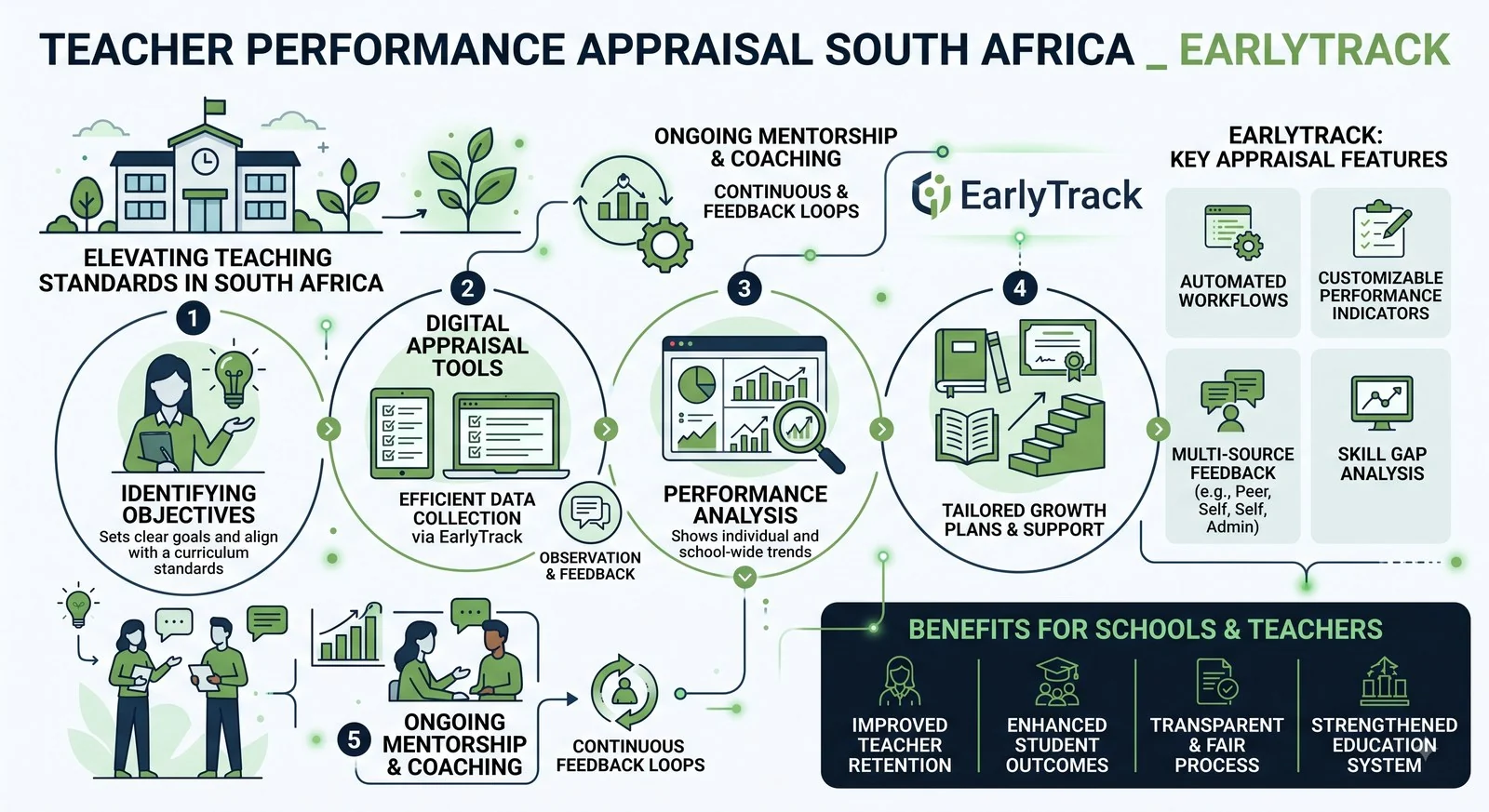
You choose who scores. The school, the teacher herself, and a peer all score the same scorecard from their own phones. Every score stays blind until the assessment closes, so nobody anchors on anyone else. When it seals, everyone sees the same result at the same moment, and the result cannot be quietly edited afterwards.
From there the system records the feedback conversation, captures real signatures from both sides, and files a branded PDF report straight into the staff file. If a teacher disagrees, her objection is captured on the record instead of being argued away. Every view of a staff record is logged, which is what POPIA asks of you.
A teacher with no smartphone and no email address can still take part, because that is the reality in a lot of South African schools. The whole module works in English and Afrikaans, and it sits alongside Staff Management and Leave Management on the same system, so the appraisal, the leave record and the staff file are never in three different places.
It is the difference between a folder of photocopied forms and a record you would be comfortable putting on a table.
Teacher performance appraisal FAQs
Give every teacher an appraisal she can trust.
EarlyTrack runs school, self and peer scoring on one scorecard, keeps every score blind until it seals, records the feedback meeting, and files a signed PDF report in the staff file. Try it free for 14 days.
Start Free 14-Day Trial